
Jurisdiction: STATE-SPECIFIC: CALIFORNIA
5-minute read
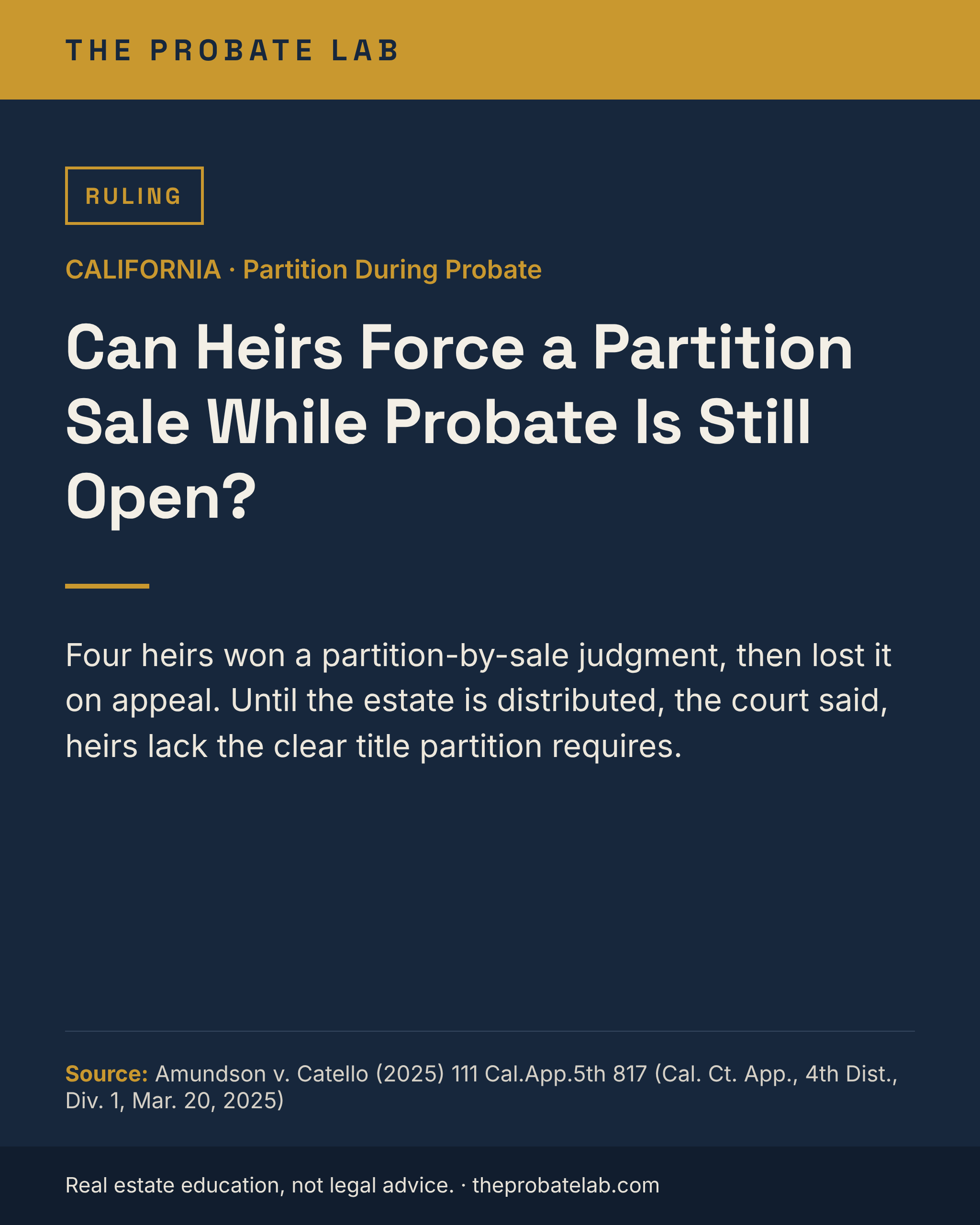
Bottom line: In California, heirs cannot file for partition during probate and force a sale in their own names while their ownership remains unresolved.[1] Applying Code of Civil Procedure section 872.210, the court said “the party seeking partition must have clear title.”[1][2] While an estate is under administration, Probate Code section 9823 gives the personal representative the authority to bring a partition action against the other co-owners.[3]
What happens when a family sits across from you and asks, “We’re the heirs — can’t we just force the sale?” If you assume being listed as an heir is enough to file a Partition lawsuit while the estate is still in probate court, how much time and money could be lost if that assumption turns out to be wrong? In a published California appellate decision, Amundson v. Catello (2025) 111 Cal.App.5th 817, four heirs found out the hard way after spending more than two years in litigation, only to have their partition judgment reversed on appeal.[1] Because this is a California appellate decision, remember that other states’ rules differ.
This is real estate education, not legal advice. Rules vary by state.
How did a last-minute deed set up a multi-year title dispute?
When you evaluate a property involving both probate and a co-owner, how closely do you look at the deed history before taking a side? Leslie J. Knoles died in 2020, allegedly having never married and leaving no children, which made her four siblings her heirs.[1] Under a 2005 deed, Knoles and Ruth Catello held the property—a parcel with a house and an accessory dwelling unit—as joint tenants with right of survivorship.[1] However, in September 2020, just weeks before Knoles died, a quitclaim deed from Knoles to herself was recorded.[1] If valid, that deed severed the joint tenancy and created a tenancy in common.[1]
The estate then played out in two courtrooms. In November 2020, the siblings opened probate, and in February 2021, Catello filed a competing petition for letters of administration.[1] About a year later, the probate court appointed an estate administrator, and in March 2023, Catello petitioned to administer a will, with trial on the competing petitions set for August 2025.[1] Meanwhile, in February 2022, Catello sued two siblings to quiet title, seeking to cancel the quitclaim deed and claiming the whole property.[1] In May 2022, all four siblings cross-claimed to partition the property by sale, suing as individuals rather than for the estate.[1]
Deed history determines whether an estate holds a tenancy in common interest or a surviving joint tenant takes the whole property.
Why did the appellate court reverse the sale after more than two years?
If the opposing side never objects to who filed the lawsuit in the trial court, is the judgment safe? In the trial court, Catello never challenged the siblings’ standing.[1] In January 2023, the San Diego Superior Court entered an interlocutory judgment for partition by sale, ordering the proceeds split equally between the estate and Catello after costs, liens, and the siblings’ attorney fees.[1] Yet on March 20, 2025, the California Court of Appeal, Fourth District, Division One (No. D082158, certified for publication) reversed the judgment, ordering that each side bears its own costs on appeal.[1] Standing can be raised for the first time on appeal, which is how a judgment entered in January 2023 was undone in March 2025.[1]
Why didn’t the siblings have standing? Code of Civil Procedure section 872.210 lets only an owner of an estate of inheritance bring a partition action, and the court stated that “the party seeking partition must have clear title”.[1][2] Under Probate Code section 7000, title passes to heirs at death, but it stays subject to administration.[4] Because the probate petitions were still awaiting trial, if the probate court ruled for Catello, she would take half, leaving the siblings’ ownership unresolved.[1] Citing Bank of Ukiah v. Rice (1904), the court explained that heirs have no interest that will let them maintain a partition action until distribution.[1]
Heirs lack standing to maintain an individual partition lawsuit while probate is open and their ownership remains unresolved.
Who actually has the authority to file for partition during probate?
If the heirs cannot sue in their own names prior to distribution, does that mean a co-owned property is completely frozen until probate closes? Not at all—if you know who holds the statutory power to act. Under Probate Code section 9823, the personal representative is authorized to bring a partition action against the other co-owners.[3] By contrast, the siblings cited no authority giving a contingent heir the same right.[1]
What if the estate administrator simply steps aside and lets the heirs run the lawsuit? The siblings tried to rely on a stipulation in which the administrator deferred to the siblings and agreed to be bound.[1] That stipulation did not fix standing: the administrator did not assign the claim to them, and the court found no statutory authority for assigning an estate’s partition claim.[1]
During estate administration in California, the appointed personal representative is the one with statutory authority to bring a partition action on the estate’s behalf.
Which questions should you ask before anyone files to sell?
Before you invest time preparing a property for market or advising a family on their options, how can you spot a standing problem before it derails the deal? Walking through three questions can help clarify where the transaction stands:
- Has the probate court entered an order for distribution, or is the estate still under administration with competing petitions pending?[1][4]
- Are the people seeking a partition sale suing as individual heirs, or is the appointed personal representative bringing the action under Probate Code section 9823?[1][3]
- Is there an unresolved quiet title claim or a disputed quitclaim deed severing a joint tenancy that leaves clear title in question?[1][2]
Asking who holds clear title and statutory authority upfront can prevent years of wasted litigation.
Where to go from here
When heirs ask you to force a sale while probate is still open, do you know where to get the answer? If you don’t know where to get the answer, the Elite Partition System is for you.
Elite Partition System — enroll now for $597; course access opens in Q4 2026
Knowing the rules of standing and title before a lawsuit is filed protects both your clients and your business.
Sources
- Amundson v. Catello (2025) 111 Cal.App.5th 817, Court of Appeal of California, Fourth Appellate District, Division One, No. D082158, filed March 20, 2025, certified for publication. https://www.courts.ca.gov/opinions/archive/D082158.PDF
- California Code of Civil Procedure § 872.210. https://leginfo.legislature.ca.gov/faces/codes_displaySection.xhtml?lawCode=CCP§ionNum=872.210
- California Probate Code § 9823. https://leginfo.legislature.ca.gov/faces/codes_displaySection.xhtml?lawCode=PROB§ionNum=9823
- California Probate Code § 7000. https://leginfo.legislature.ca.gov/faces/codes_displaySection.xhtml?lawCode=PROB§ionNum=7000
Every source above was checked against the original on November 7, 2026.
Quick answers
When you evaluate a property involving both probate and a co-owner, how closely do you look at the deed history before taking a side? Leslie J. Knoles died in 2020, allegedly having never married and leaving no children, which made her four siblings her heirs. Under a 2005 deed, Knoles and Ruth Catello held the property—a parcel with a house and an accessory dwelling unit—as joint tenants with right of survivorship.
If the opposing side never objects to who filed the lawsuit in the trial court, is the judgment safe? In the trial court, Catello never challenged the siblings’ standing. In January 2023, the San Diego Superior Court entered an interlocutory judgment for partition by sale, ordering the proceeds split equally between the estate and Catello after costs, liens, and the siblings’ attorney fees.
If the heirs cannot sue in their own names prior to distribution, does that mean a co-owned property is completely frozen until probate closes? Not at all—if you know who holds the statutory power to act. Under Probate Code section 9823, the personal representative is authorized to bring a partition action against the other co-owners. By contrast, the siblings cited no authority giving a contingent heir the same right.
Before you invest time preparing a property for market or advising a family on their options, how can you spot a standing problem before it derails the deal? Walking through three questions can help clarify where the transaction stands:

Leave a Reply