
Most people treat the accounting in a partition action as the thing that happens at the end — the arithmetic of who gets what out of the proceeds, worked out after the closing.
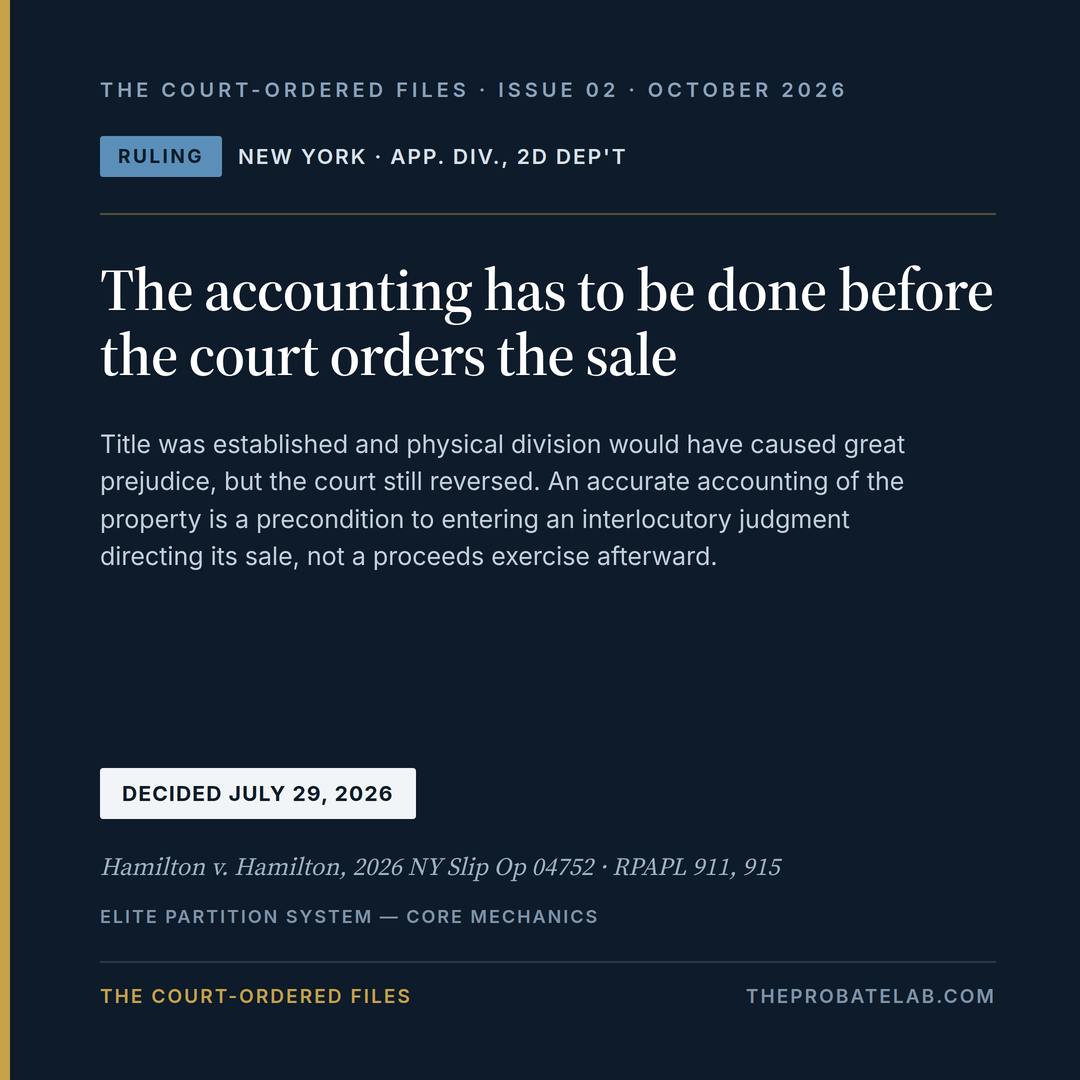
Hamilton v. Hamilton, decided July 29, 2026, puts it at the other end.1
The plaintiffs had done what the cases ask for. They established title. They showed that physical division would cause great prejudice. The trial court entered an interlocutory judgment of partition and sale.
The Second Department reversed anyway: “The Supreme Court failed to ensure that there was an accurate accounting of the subject property before the entry of an interlocutory judgment directing its sale.” Citing RPAPL 911 and 915, it remitted.
The practical read
The accounting is a precondition to the order that authorizes the sale, not a clean-up after it. Which means a sale order sitting in a file where no accounting has been done is an order that may not survive an appeal.
For anyone whose work starts after the sale order — listing, marketing, closing — that is a timeline question and a commission question rather than a procedural footnote. The order is what you are relying on, and this says something about what it takes for that order to hold.
A fair question for your current partition files: do you know, on any of them, whether the accounting has been completed? And if not, who would you ask?
This article is real-estate education, not legal advice.
Partition files are their own discipline. The Elite Partition System (coming Q4 2026) teaches the co-owner and court-ordered partition sale from title check to closing, in all 50 states. For probate and estate property, EPCAS™ — Elite Probate Client Acquisition System covers the same authority-first discipline.
Leave a Reply