When a co-owner refuses to sell, most people assume the property is stuck. It usually isn’t. The legal path is called “Partition”, and most families, and many real estate professionals, have never heard the word. Below are 12 real situations where “Partition” (or something that works like it) decides what happens to the property, each with the law behind it.1
Educational only, not legal advice. “Partition” rules vary by state; California statutes are cited as examples.
1. Your co-owner refuses to sell. Now what?
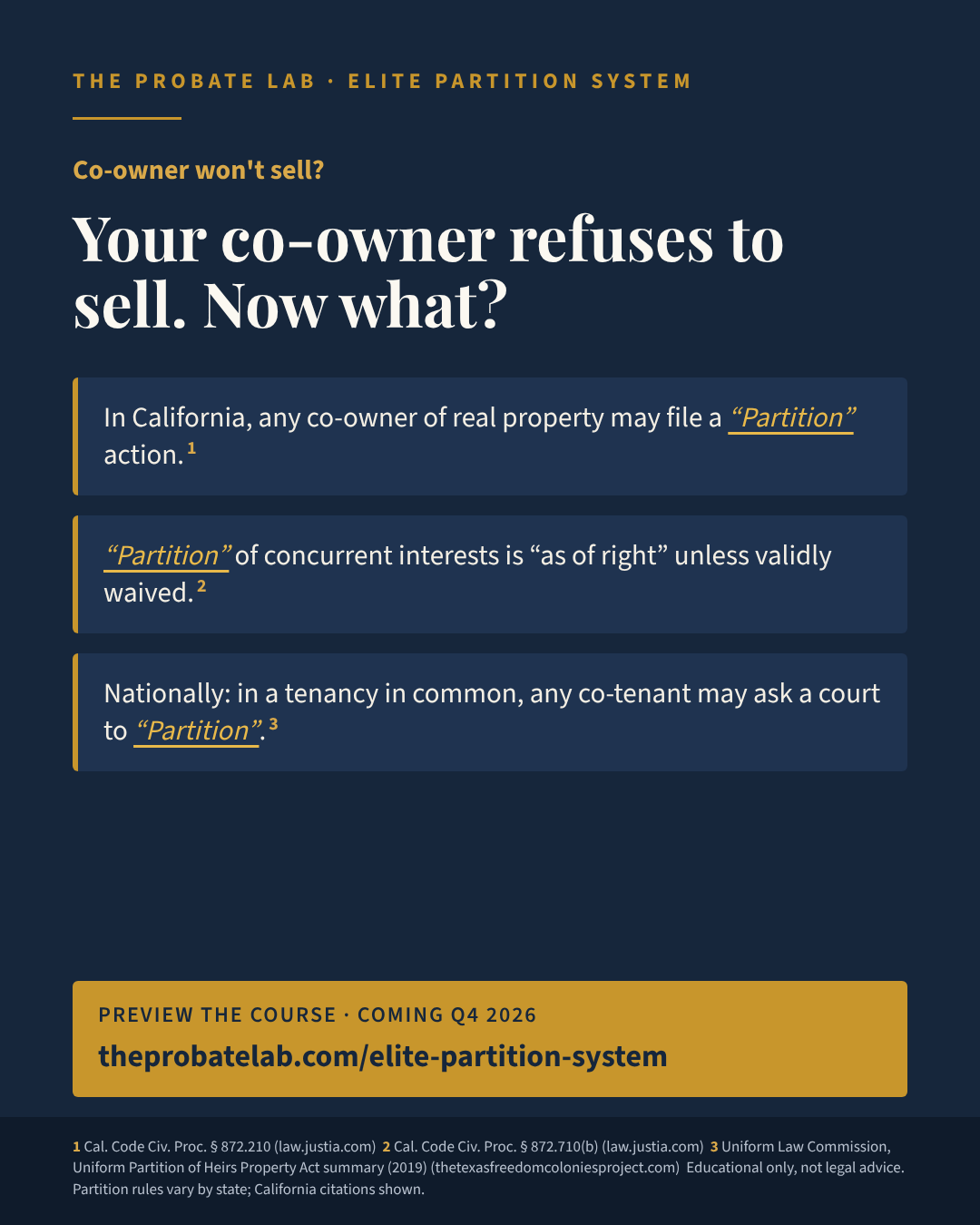
Your co-owner refuses to sell. Now what? When people who own a property together can't agree, there's a legal path called “Partition”. Most agents never learn it. Elite Partition System, coming Q4 2026: theprobatelab.com/elite-partition-system/
- In California, any co-owner of real property may file a “Partition” action.1
- “Partition” of concurrent interests is “as of right” unless validly waived.2
- Nationally: in a tenancy in common, any co-tenant may ask a court to “Partition”.3
2. Can a co-owner force the sale of a house?
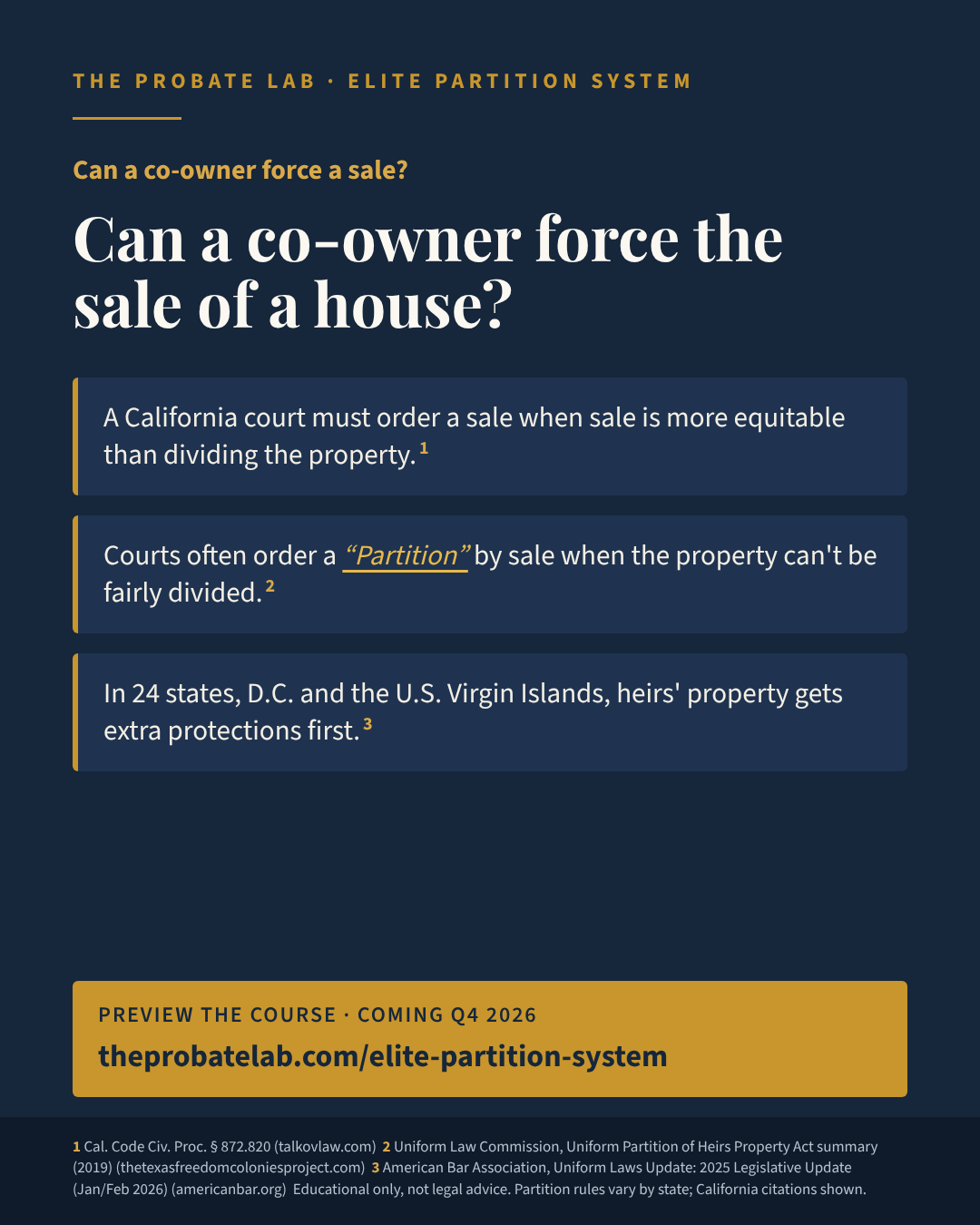
Can a co-owner force the sale of a house? In many cases a court can order one through a “Partition” action. The real question for agents and investors: do you recognize the file when it's in front of you?
- A California court must order a sale when sale is more equitable than dividing the property.4
- Courts often order a “Partition” by sale when the property can't be fairly divided.3
- In 24 states, D.C. and the U.S. Virgin Islands, heirs' property gets extra protections first.5
3. One sibling wants to sell. The other wants to keep it.
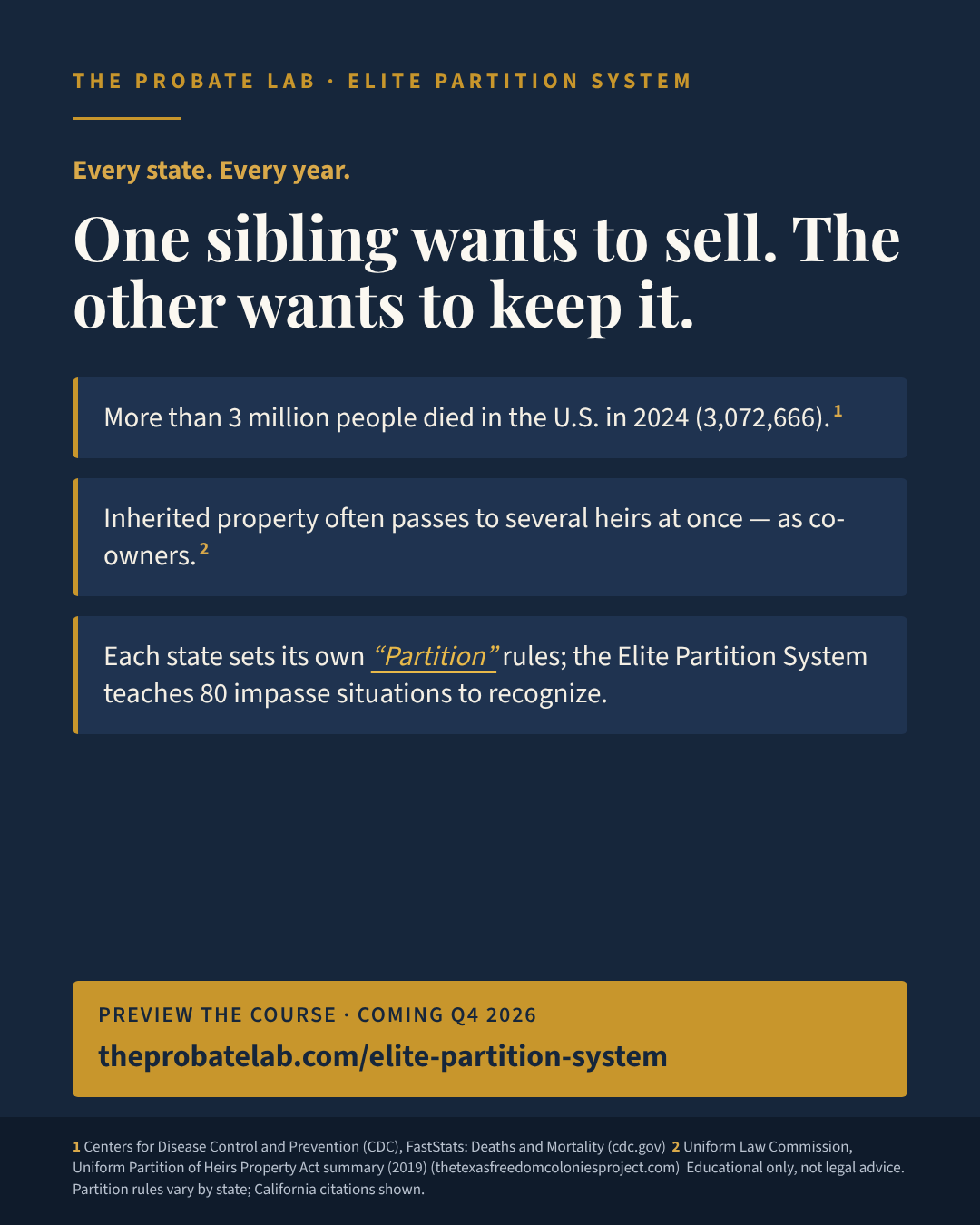
One sibling wants to sell the inherited house. The other wants to keep it. That standoff happens in every state, and it's one of 80 situations the Elite Partition System teaches you to recognize.
- More than 3 million people died in the U.S. in 2024 (3,072,666).6
- Inherited property often passes to several heirs at once — as co-owners.3
- Each state sets its own “Partition” rules; the Elite Partition System teaches 80 impasse situations to recognize.
4. How do you buy out a sibling from an inherited house?
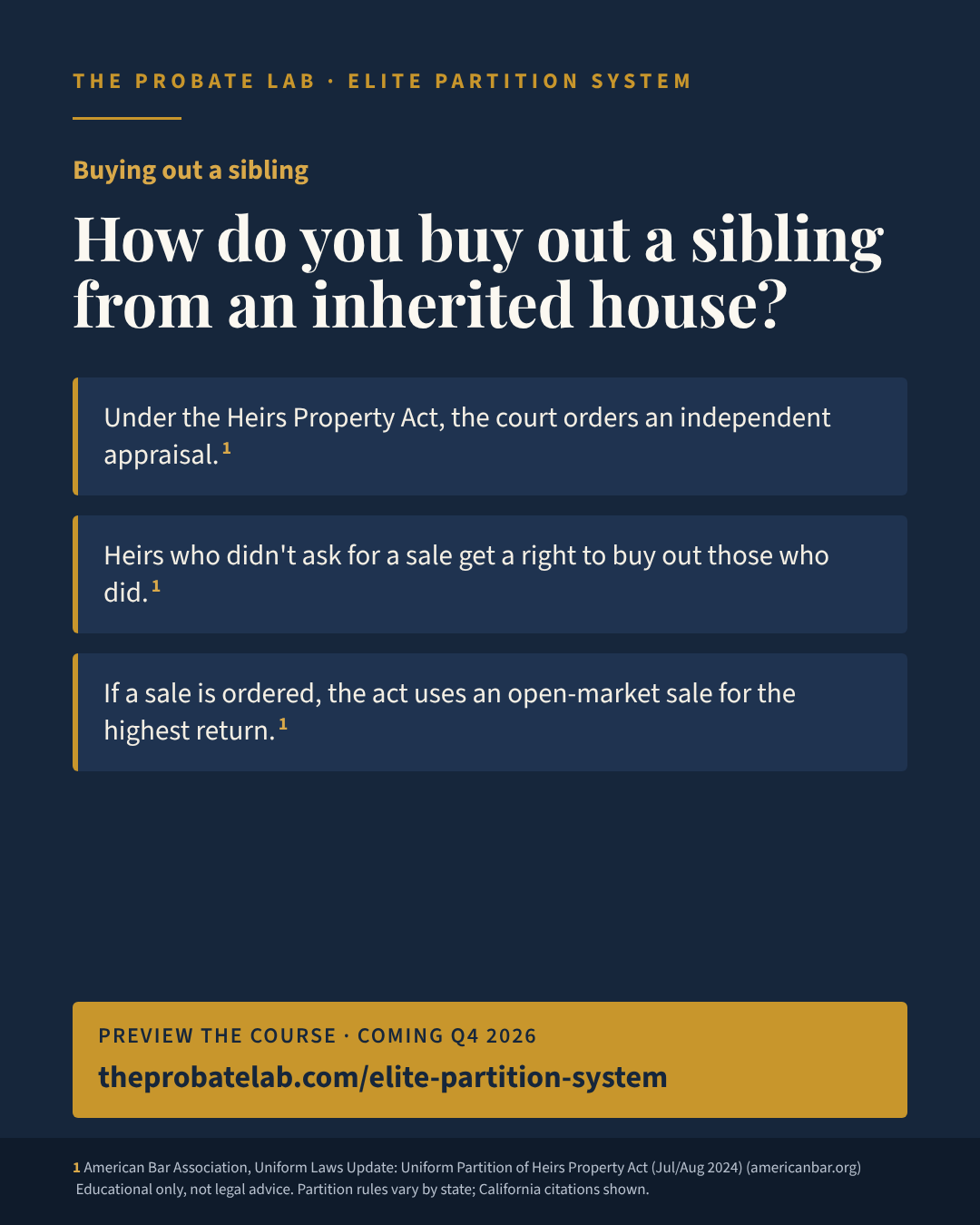
How do you buy out a sibling from an inherited house? First, someone has to agree on the value. When the appraisals don't match and the buyout falls apart, the property doesn't just sit. Know the next step.
- Under the Heirs Property Act, the court orders an independent appraisal.7
- Heirs who didn't ask for a sale get a right to buy out those who did.7
- If a sale is ordered, the act uses an open-market sale for the highest return.7
5. Paying the utilities doesn't make the house yours.
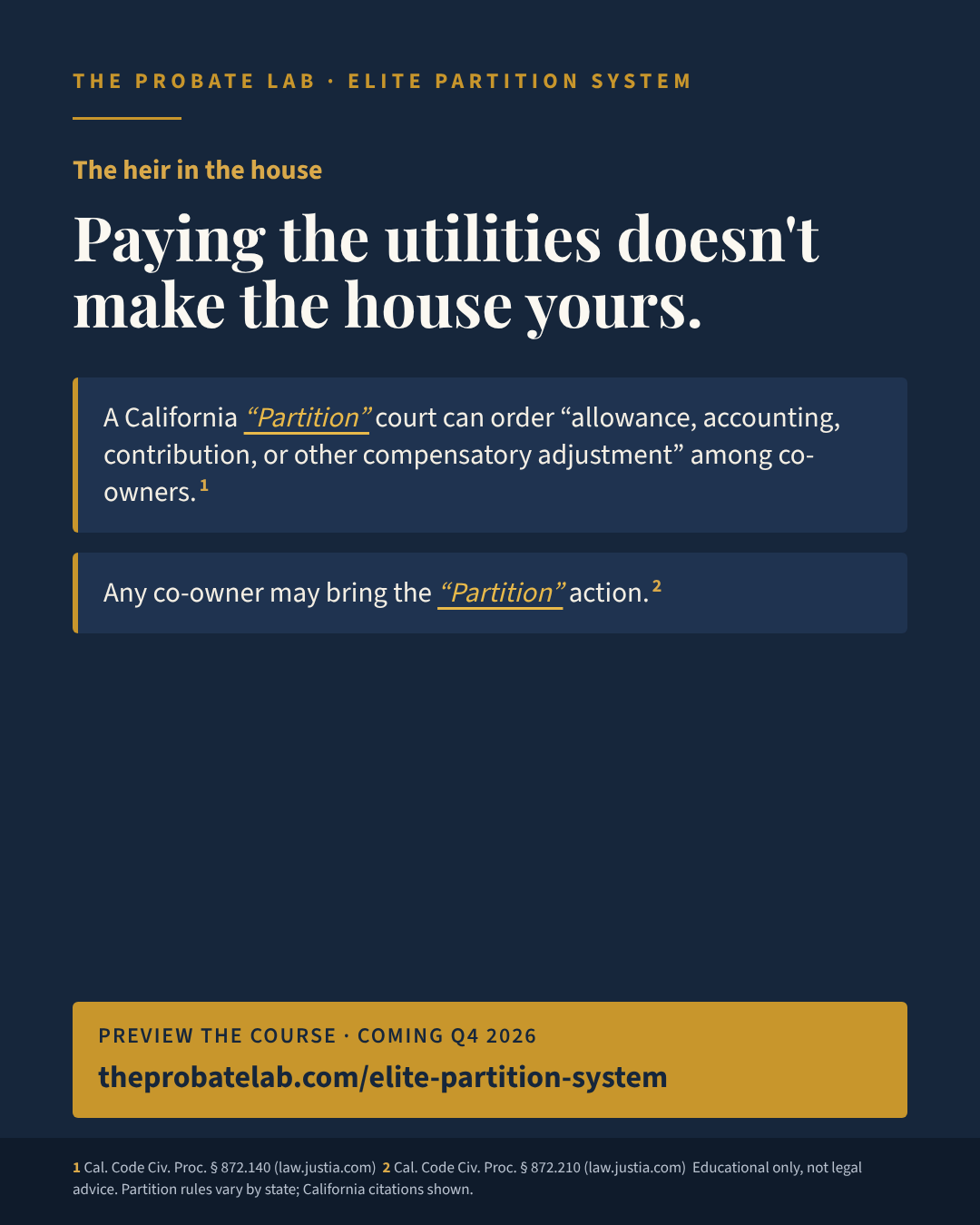
The heir living in the house pays the utilities and thinks that means they can stay forever. The others get nothing. That's a “Partition” conversation waiting to happen.
- A California “Partition” court can order “allowance, accounting, contribution, or other compensatory adjustment” among co-owners.8
- Any co-owner may bring the “Partition” action.1
6. Divorce functions like “Partition”.
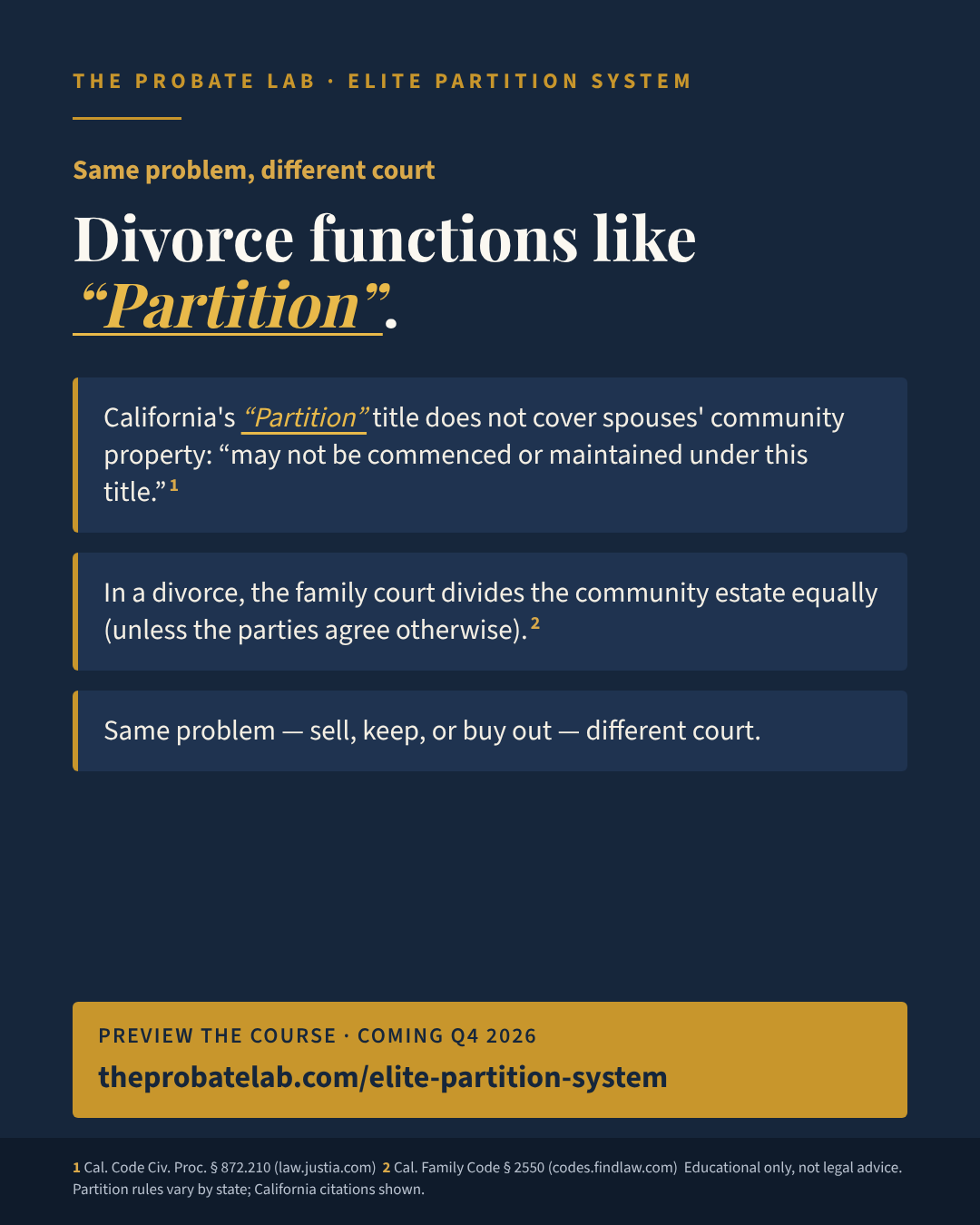
Divorce functions like “Partition”. One spouse wants to sell, one wants to stay, and nobody can fund the buyout. Same problem, different court: in California, “Partition” between spouses over community property runs through family court, not the “Partition” statute (Code of Civil Procedure section 872.210). Know “Partition” first, and you'll see the opportunity in divorce files too.
- California's “Partition” title does not cover spouses' community property: “may not be commenced or maintained under this title.”1
- In a divorce, the family court divides the community estate equally (unless the parties agree otherwise).9
- Same problem — sell, keep, or buy out — different court.
7. Divorce functions like “Partition” — but it isn't called “Partition”.
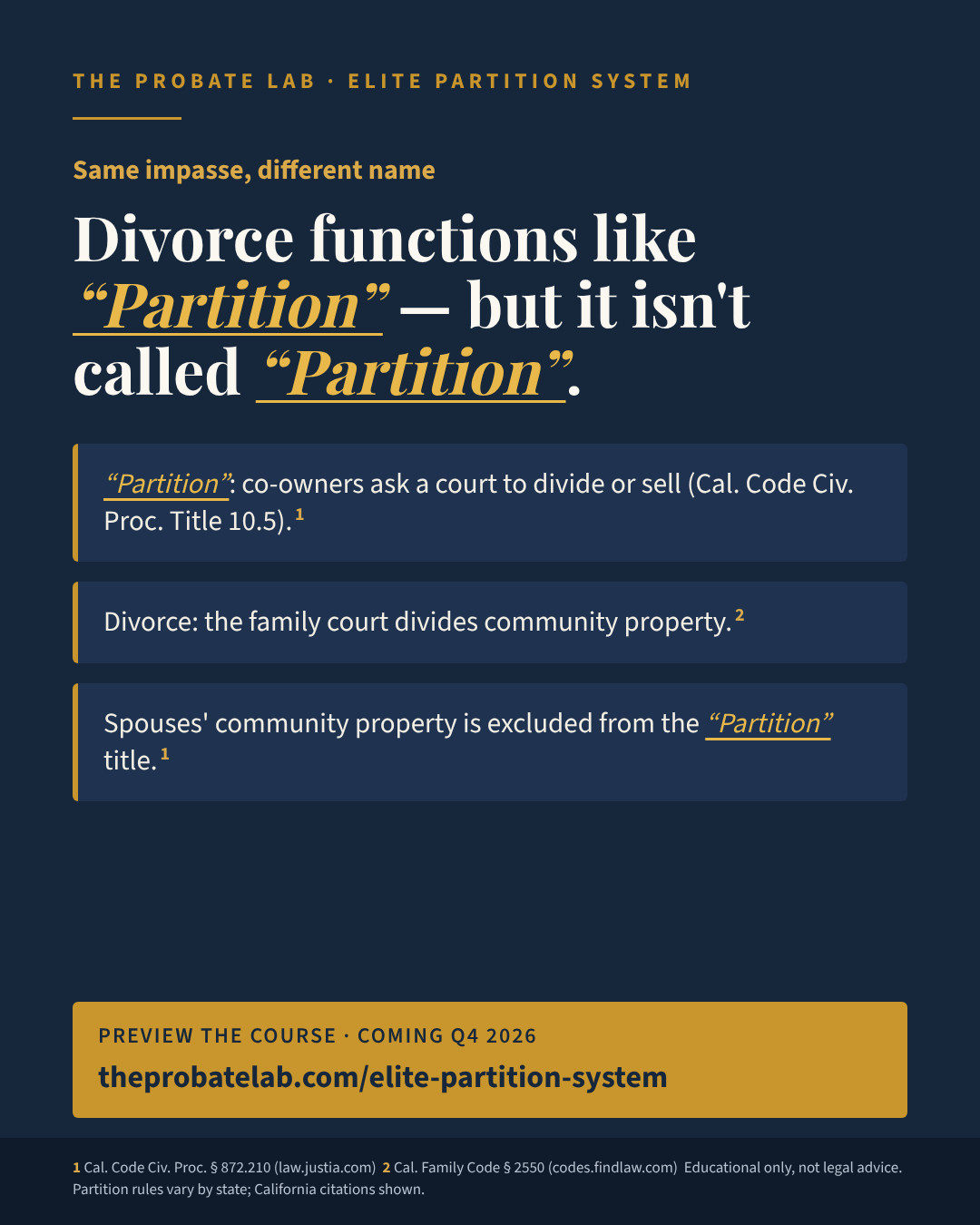
Divorce functions like “Partition”, but it isn't called “Partition”. If you only know one, you miss the other. Agents and investors who understand both serve families most professionals walk past.
- “Partition”: co-owners ask a court to divide or sell (Cal. Code Civ. Proc. Title 10.5).1
- Divorce: the family court divides community property.9
- Spouses' community property is excluded from the “Partition” title.1
8. One owner paid the mortgage for six years. The other paid nothing.
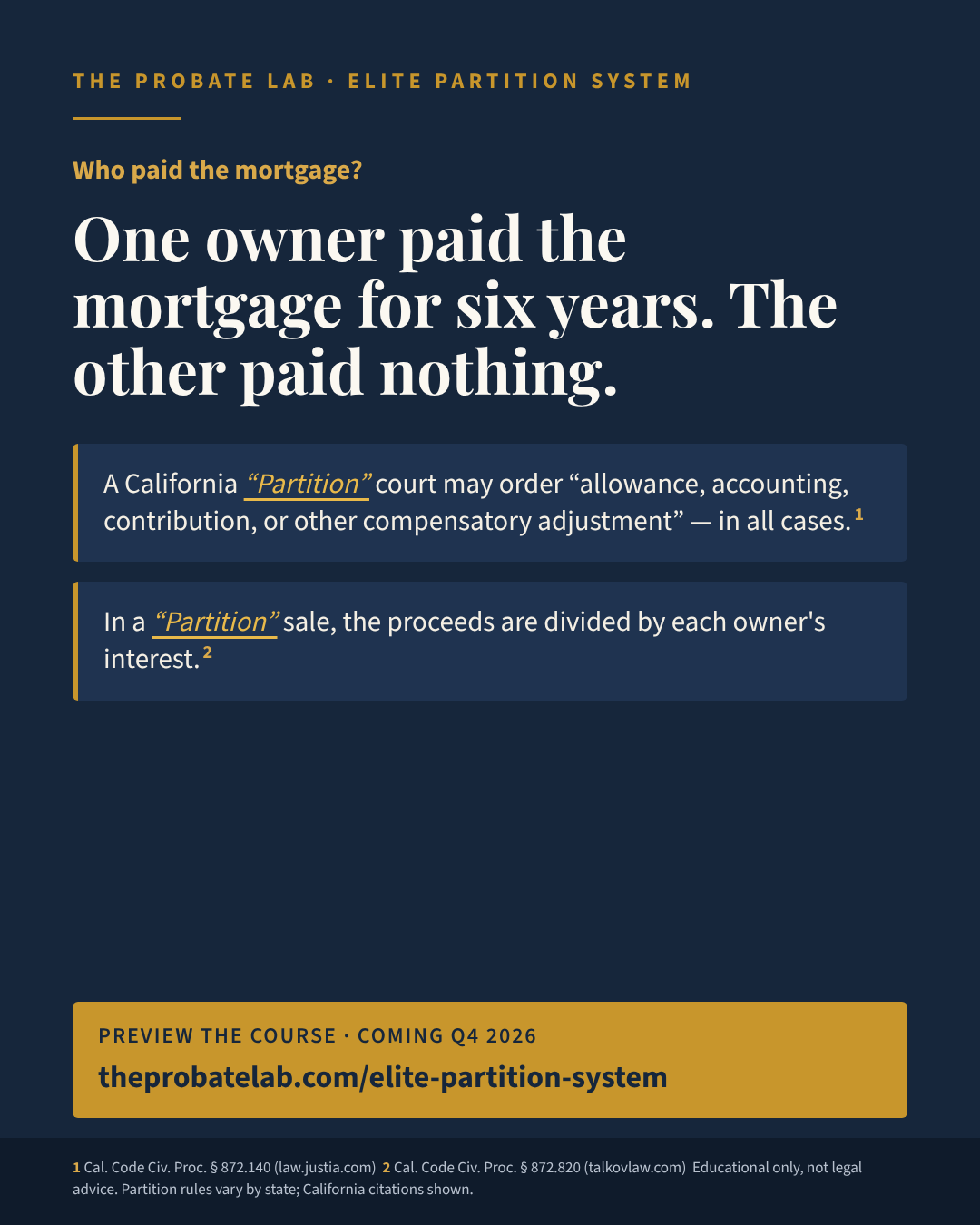
One owner paid the mortgage for six years. The other paid nothing. Who gets what when it sells? In a “Partition”, the accounting matters as much as the sale.
- A California “Partition” court may order “allowance, accounting, contribution, or other compensatory adjustment” — in all cases.8
- In a “Partition” sale, the proceeds are divided by each owner's interest.4
9. Everyone agrees to sell. Nobody agrees on anything else.
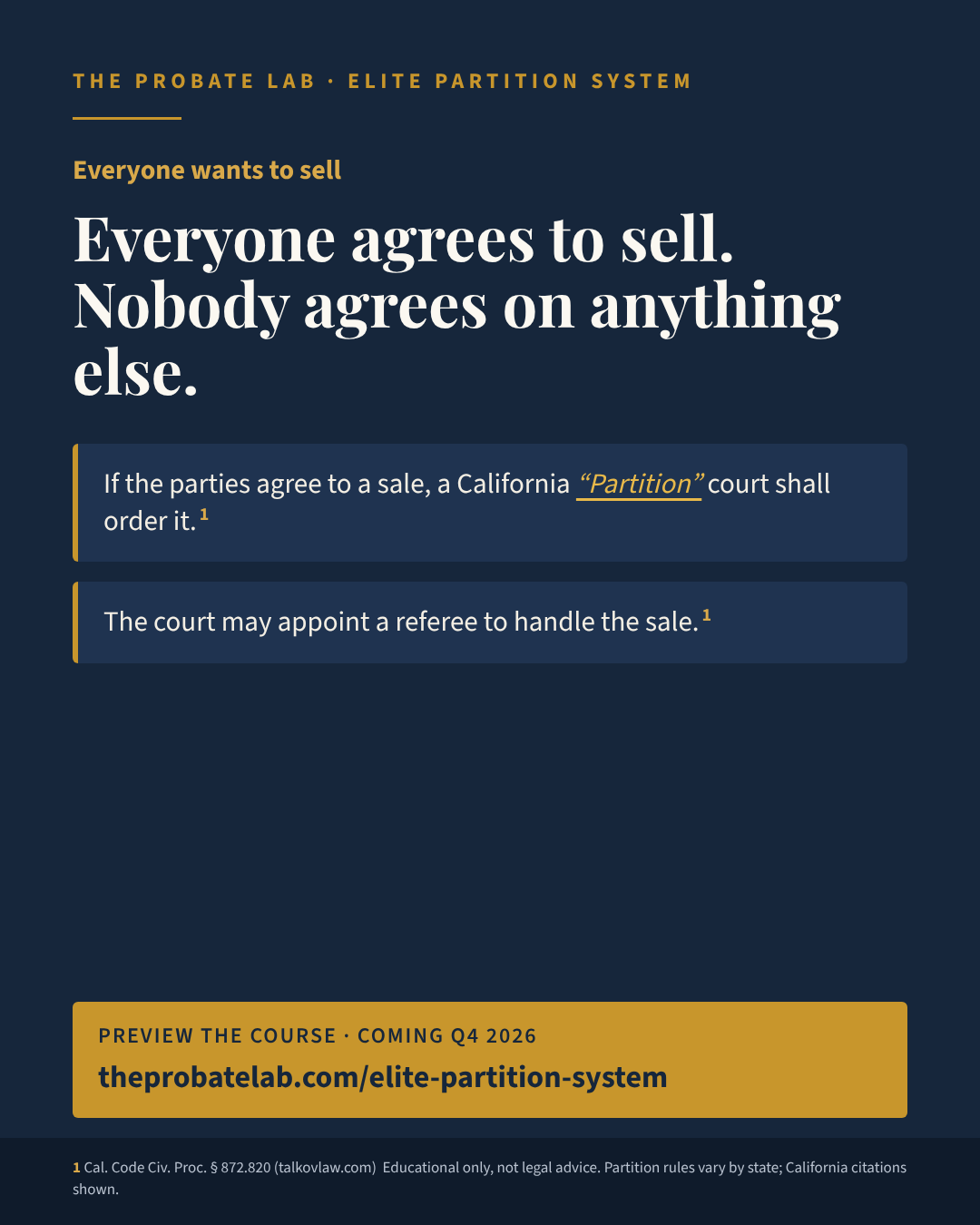
Everyone agrees to sell. Nobody agrees on the price, the timing, or the offer. That's still an impasse, and it still needs someone who knows the process.
- If the parties agree to a sale, a California “Partition” court shall order it.4
- The court may appoint a referee to handle the sale.4
10. Probate has its own version of “Partition”.
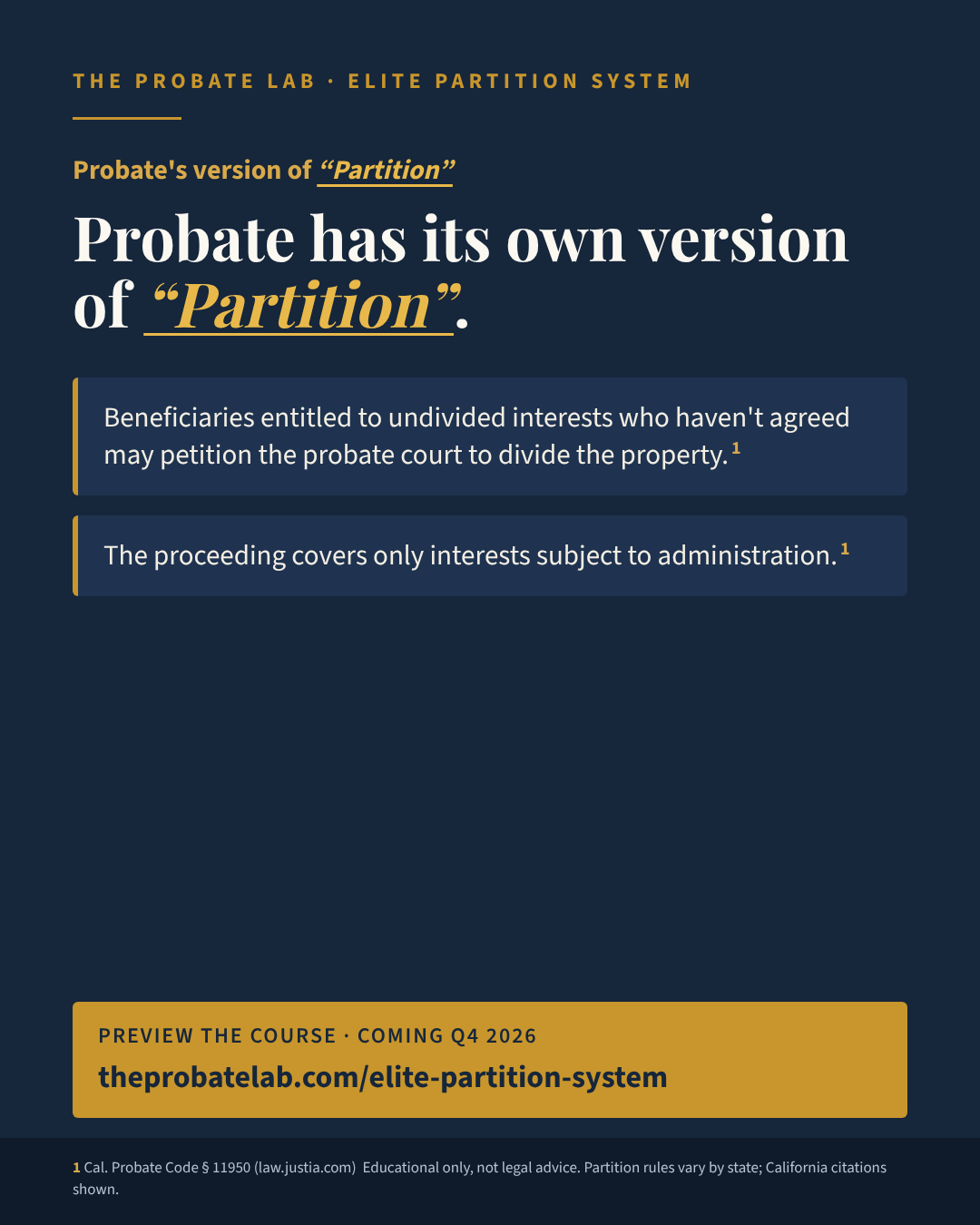
Probate has its own version of “Partition”. In California, heirs who disagree over how estate property is distributed can ask the probate court to decide (Probate Code section 11950). Being a beneficiary is not the same as owning title. Know the difference.
- Beneficiaries entitled to undivided interests who haven't agreed may petition the probate court to divide the property.10
- The proceeding covers only interests subject to administration.10
11. Two friends bought a rental together. Now one wants out.
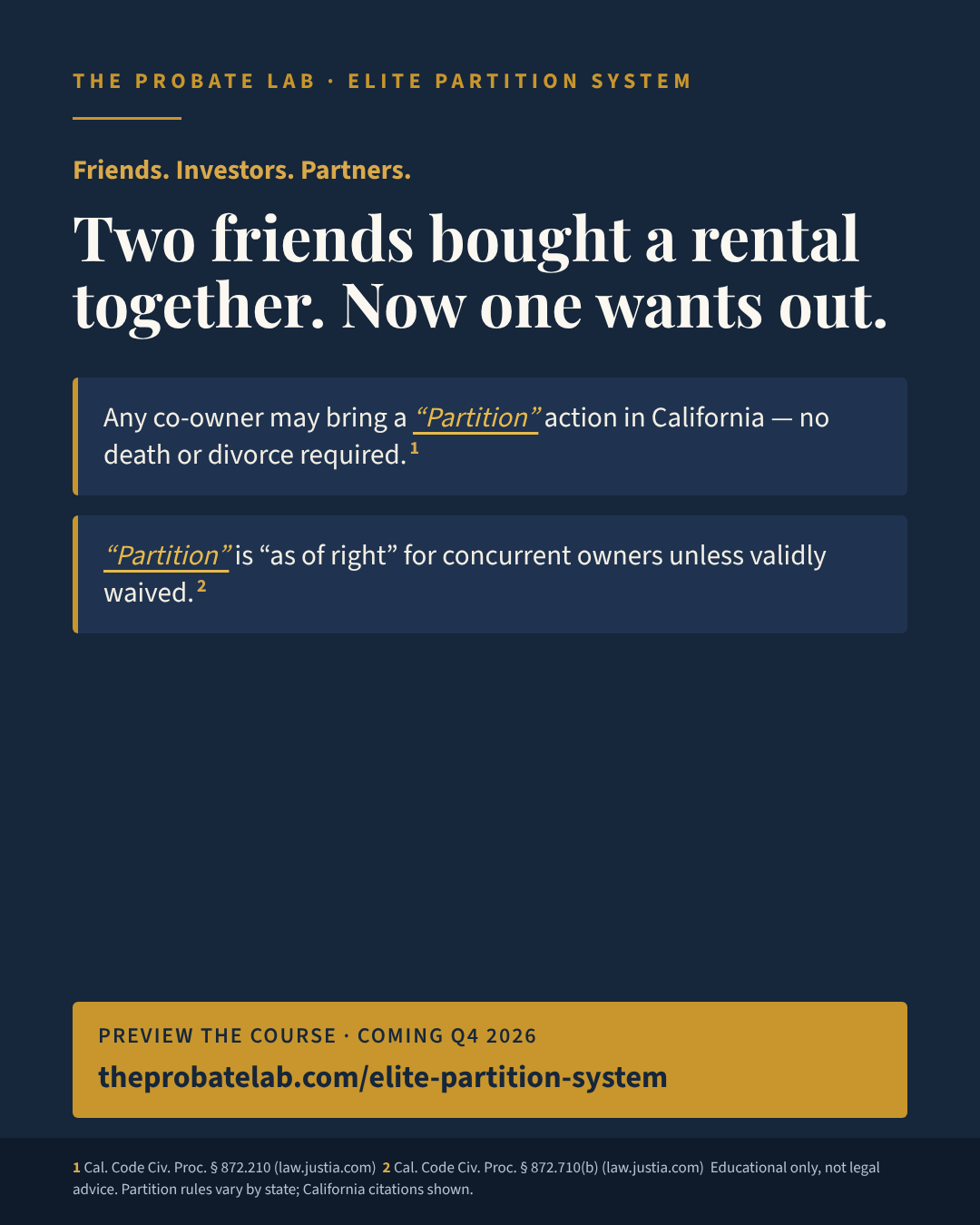
Two friends bought a rental together. Now one wants out and the other wants the income. Co-ownership disputes don't need a death or a divorce to end up in court.
- Any co-owner may bring a “Partition” action in California — no death or divorce required.1
- “Partition” is “as of right” for concurrent owners unless validly waived.2
12. Bring your referral partners a “Partition” capability.
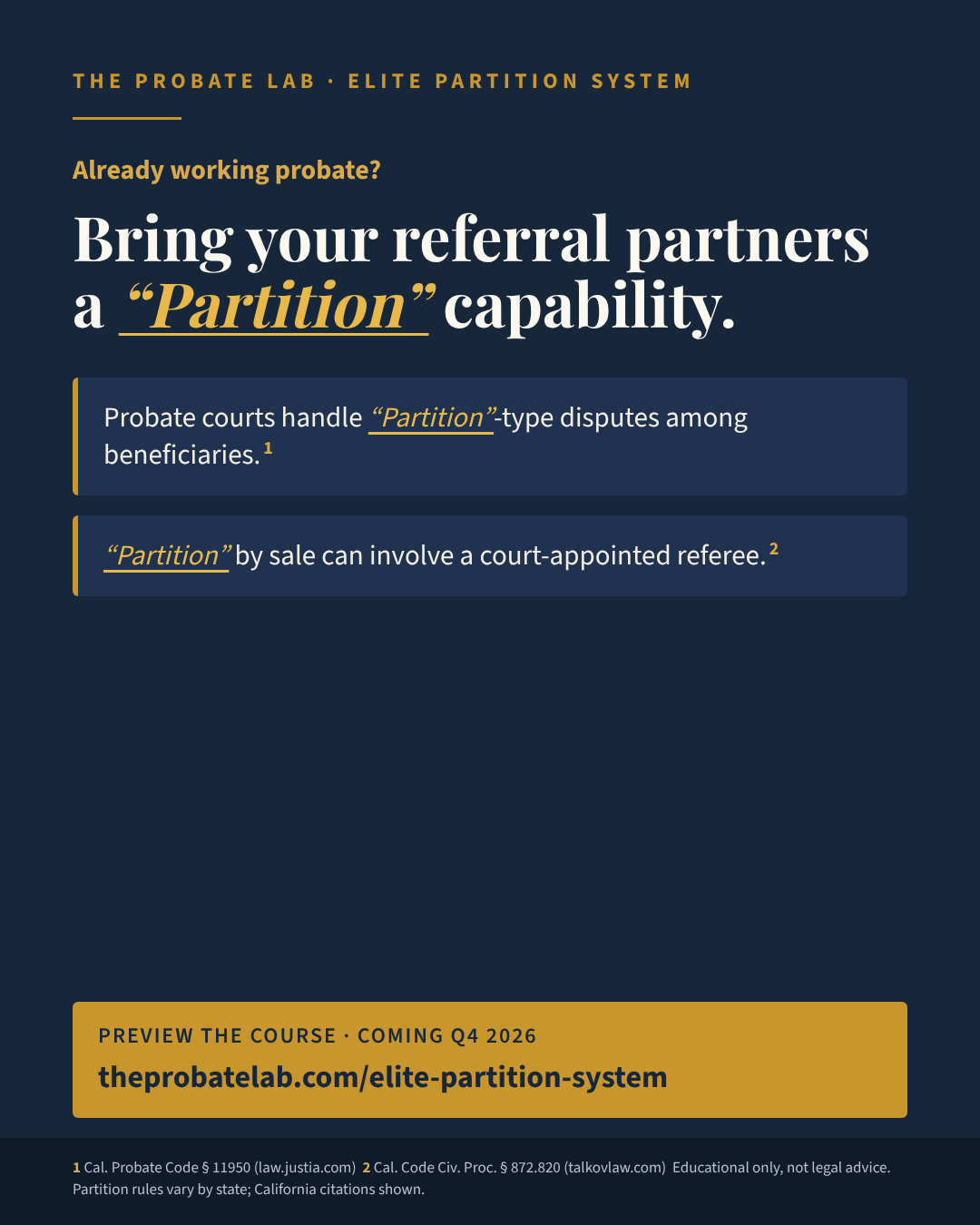
Already working probate? Fiduciaries, probate referees and probate attorneys see co-ownership fights every month. Bring them a “Partition” capability they rarely find. Preview the course: theprobatelab.com/elite-partition-system/
- Probate courts handle “Partition”-type disputes among beneficiaries.10
- “Partition” by sale can involve a court-appointed referee.4
Learn to recognize the “Partition” file
The Elite Partition System (coming Q4 2026) teaches agents and investors to recognize these situations and work them, in all 50 states. It builds on EPCAS, our probate training for real estate agents. Not sure where you stand? Take the free probate quiz.
Sources
- Cal. Code Civ. Proc. § 872.210 — law.justia.com
- Cal. Code Civ. Proc. § 872.710(b) — law.justia.com
- Uniform Law Commission, Uniform Partition of Heirs Property Act summary (2019) — www.thetexasfreedomcoloniesproject.com
- Cal. Code Civ. Proc. § 872.820 — talkovlaw.com
- American Bar Association, Uniform Laws Update: 2025 Legislative Update (Jan/Feb 2026) — www.americanbar.org
- Centers for Disease Control and Prevention (CDC), FastStats: Deaths and Mortality — www.cdc.gov
- American Bar Association, Uniform Laws Update: Uniform Partition of Heirs Property Act (Jul/Aug 2024) — www.americanbar.org
- Cal. Code Civ. Proc. § 872.140 — law.justia.com
- Cal. Family Code § 2550 — codes.findlaw.com
- Cal. Probate Code § 11950 — law.justia.com
Leave a Reply