
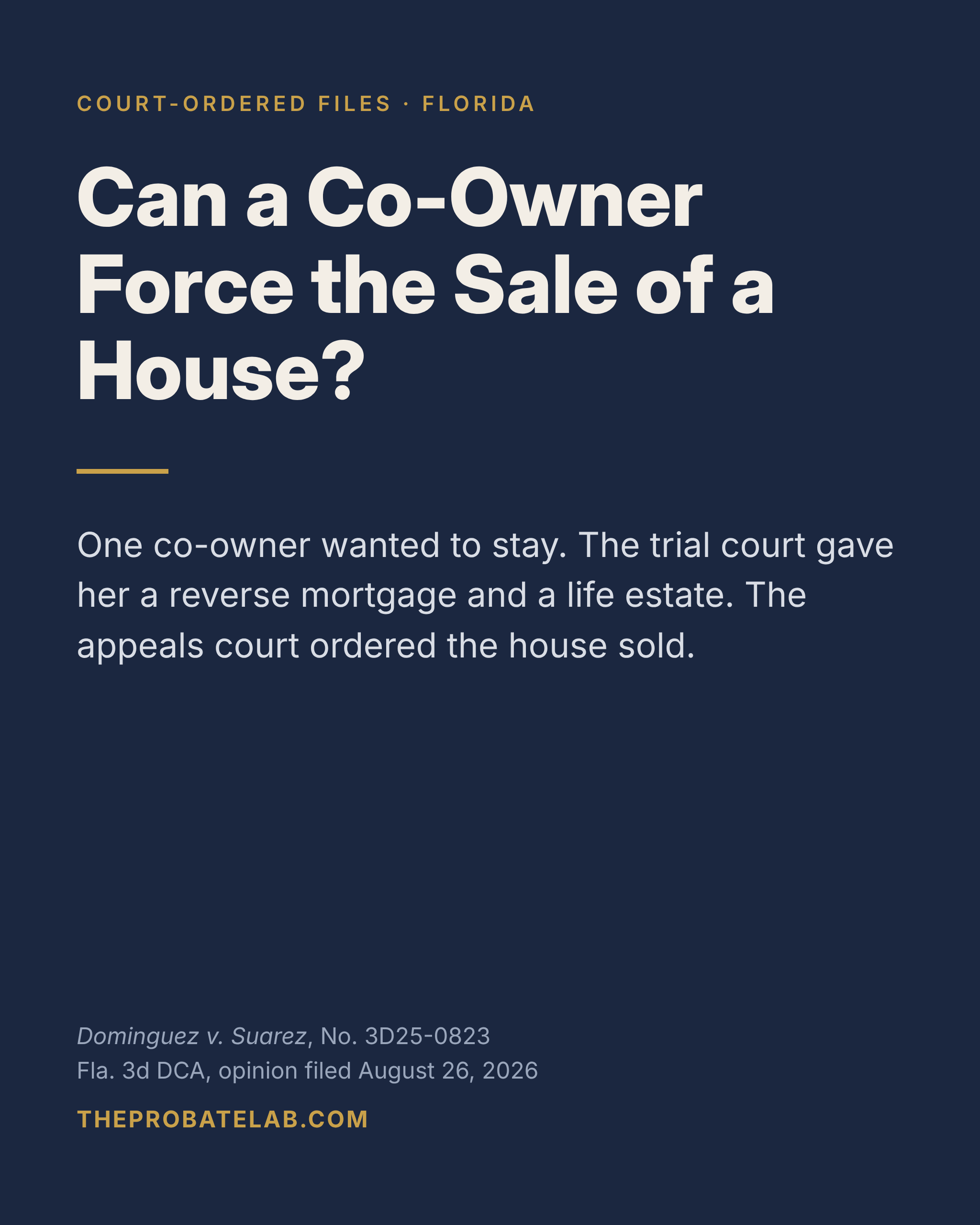
Bottom line: When three people own one house and one of them will not leave, the others can force the sale of a house they cannot divide. On August 26, 2026, a Florida appeals court said so plainly: partition by sale. The home gets sold, the money gets divided, and the books get squared. Agents, investors, if a co-owner told you tomorrow, “I’m not going anywhere,” do you know what you would say next?
Jurisdiction: State-specific: Florida. Partition rules differ from state to state.
5-minute read
This is real estate education, not legal advice. Rules vary by state.
Picture the house. A single-family home in Miami-Dade County. Three names on a 2013 deed, each holding one-third. One of the three lives there. She wants to stay. She has made the coffee in that kitchen for years, and she is not interested in a sale.
The other two want out.
That is not a rare story. It is the most ordinary story in court-ordered real estate. Families buy together, inherit together, divorce apart, and one day the people on the deed stop wanting the same thing. What happens next decides whether everyone walks away whole or whether the house becomes the thing they fight over for the rest of their lives.
What happened in Dominguez v. Suarez?
The two co-owners who wanted out filed for partition in the Circuit Court for Miami-Dade County. After a trial without a jury, the judge refused to order partition at all.
Instead, the trial court built a remedy of its own. It ordered the co-owner living in the home to take out a reverse mortgage for the maximum amount available, pay the net proceeds equally to the other two, and deed the property so she kept an enhanced life estate, with the remainder going to the other two owners.
It sounded kind. It sounded like a way for everyone to keep the peace.
The Third District Court of Appeal reversed it.
Why did the appeals court order partition by sale?
The court, in an opinion written by Judge Gordo with Judges Lobree and Gooden on the panel, gave three reasons.
Partition is a matter of right. Under Florida law, co-owners of property that cannot be physically divided are entitled to partition. A court may refuse only in extreme cases, where manifest injustice, fraud, oppression, waiver or estoppel is shown. The co-owner who wanted to stay never pleaded or proved any of those. She wanted to keep living in the home. Wanting is not a legal defense.
A judge cannot hand out a remedy nobody asked for. The reverse mortgage and the life estate were never part of the pleadings. Partition does one of two things: it divides the land, or, when the land cannot be divided, it sells the property and divides the money.
The accounting was missing. The trial court never accounted for the home’s appreciation or for each owner’s proportionate share of the expenses. That accounting is required.
The case went back to the trial court with instructions to order partition by sale, followed by an accounting.
The takeaway: a co-owner’s wish to stay is not a reason the law will keep the others trapped.
Can a co-owner force the sale of a house when another refuses to leave?
In Florida, this ruling says the answer is yes, unless the one resisting proves one of the narrow defenses the court listed.
Notice something else in the facts. These owners held title as joint tenants with rights of survivorship. Many people believe that kind of deed locks everyone in until someone dies. The court still ordered the house sold.
That is the gap. Most agents, and most families, have never been told that the deed they are standing on can be ended by a lawsuit filed by the person sitting across the dinner table.
Why does a Florida ruling matter in your state?
Every state writes its own partition rules, and the details decide the outcome. In Ohio, a recent case turned on when a partition settlement actually took effect. Some states have adopted reform statutes that add appraisals, buyout rights and other steps before a forced sale. Others still run on older rules. The words “partition by sale” can mean very different things depending on where the house sits.
Whether one owner can force the sale of a house, and on what terms, depends on the state. So the question is not whether the Florida answer is your state’s answer. The question is whether you know your state’s answer before the co-owner who refuses to leave is standing in front of you, and before the family who called you hires someone who does.
The takeaway: the agent who understands partition in their own state is the one the family trusts when the deed stops working.
What do agents and investors miss when co-owners disagree?
They treat it like a listing problem. It is not. When one owner moves to force the sale of a house, it becomes a court problem with a house attached.
The co-owner who lives in the home has emotion, possession and time on her side. The co-owners who want out have the law. The professional who walks into that kitchen needs to know which conversation to have with each of them, and what the court will and will not do, before anyone signs anything.
This ruling also shows what an accounting means. Appreciation and expenses get sorted out after the sale. Who paid the taxes. Who paid the insurance. Who carried the house. Those numbers move real money from one sibling to another, and families rarely see it coming.
Where to go from here
Do you know what your state’s partition rules require before a forced sale, and what to say to the co-owner who will not leave?
If you do not know where to get that answer, the Elite Partition System is for you. It teaches agents and investors in all 50 states how partition works, state by state, including what happens when one owner tries to force the sale of a house, so you can work the files other agents walk away from.
Preview the Elite Partition System →
The house in Miami-Dade will be sold. The kitchen will belong to someone new. And three people who once signed one deed together will each walk away with their share, because a court refused to let one person’s wish outweigh everyone else’s right.
Sources
- Norma Dominguez, et al. v. Nancy Suarez, No. 3D25-0823 (Fla. 3d DCA, opinion filed August 26, 2026), on appeal from Miami-Dade Circuit Court, Lower Tribunal No. 20-23756-CA-01. Not final until disposition of any timely filed motion for rehearing. https://law.co/app/cases/9000006907
- Florida Statutes § 64.051 (Partition — Judgment). https://www.flsenate.gov/Laws/Statutes/2025/64.051
Every source above was checked against the original on November 7, 2026.
Quick answers
The two co-owners who wanted out filed for partition in the Circuit Court for Miami-Dade County. After a trial without a jury, the judge refused to order partition at all.
The court, in an opinion written by Judge Gordo with Judges Lobree and Gooden on the panel, gave three reasons.
In Florida, this ruling says the answer is yes, unless the one resisting proves one of the narrow defenses the court listed.
Every state writes its own partition rules, and the details decide the outcome. In Ohio, a recent case turned on when a partition settlement actually took effect. Some states have adopted reform statutes that add appraisals, buyout rights and other steps before a forced sale. Others still run on older rules. The words “partition by sale” can mean very different things depending on where the house sits.
They treat it like a listing problem. It is not. When one owner moves to force the sale of a house, it becomes a court problem with a house attached.

Leave a Reply