3-minute read
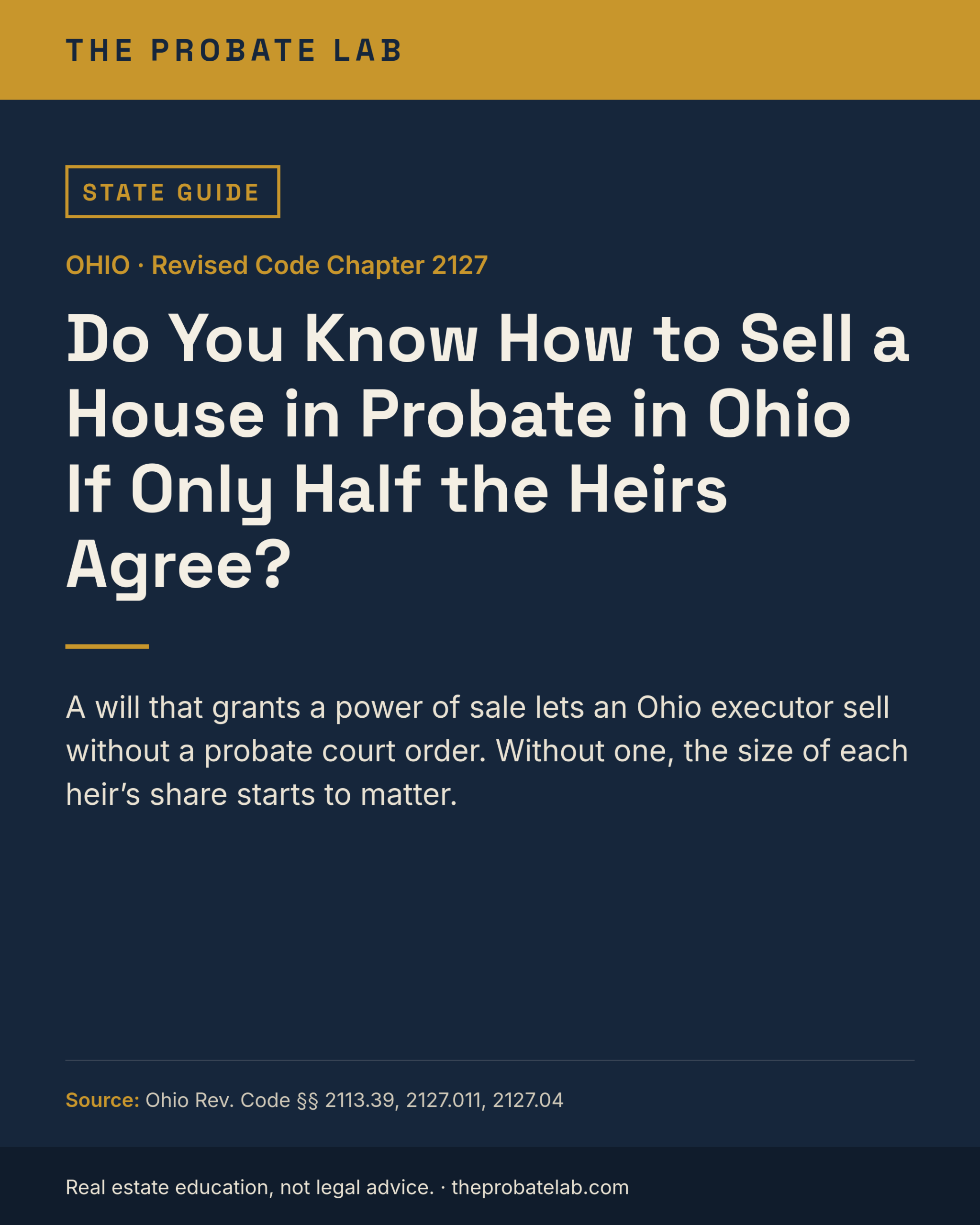
Bottom line: In Ohio, the paperwork decides who has to agree to a probate house sale. A power of sale in the will lets the executor sell without a court order; without one, the spouse and every heir or beneficiary can consent in writing, or the executor can ask the probate court to order the sale. In that court action, unanimity is not the test.
Somewhere between the turkey and the pie, one sibling says Mom’s house should be listed by spring and another says it is not for sale. In an Ohio probate, that argument at the table is not the final word. Once you know how to sell a house in probate in Ohio, you can tell which document decides who actually has to sign. The Probate Lab works with agents and investors in all 50 states.
This is real estate education, not legal advice. Work with an Ohio probate attorney on any specific estate.
Does the will already decide how to sell a house in probate in Ohio?
Start with the will. If it authorizes a qualified executor to sell real property, no order from the probate court is required for the sale, and the power covers any purpose the executor considers in the estate’s best interest unless the will expressly limits it.[1] An executor holding that power may sell under the will or under Ohio’s land-sale statutes.[2]
Read the will for a power of sale before anyone talks about price.
What if every heir is willing to sign?
When the will is silent, and unless it expressly prohibits a sale, the family can create the power itself. The surviving spouse and all legatees and devisees, or all heirs if there is no will, give written consent to a power of sale for one parcel or for all of the estate’s real property, and each consent is filed in the probate court.[3] The price must then be at least 80 percent of the appraised value in the approved inventory, and the power is not effective if the spouse or any legatee, devisee or heir is a minor.[3]
Unanimous written consent opens the faster path, with a price floor and an age limit attached.
Can the court order a sale over one heir’s objection?
Yes. An executor or administrator may file an action on their own motion to sell the decedent’s real property, even if the property is not needed to pay debts or legacies.[4] The court may order the sale when at least 50 percent of the people interested in the property consent, no written objection comes from people whose combined interests exceed 25 percent, and the court finds the sale is in the estate’s best interest.[4] A similar route applies when no one’s interest exceeds 10 percent.[4] The surviving spouse, the heirs or devisees with an interest, and every mortgagee and lienholder must be named as defendants.[5]
In a court sale, the size of an objector’s share matters more than how loudly they object.
What happens if an heir can’t be found?
If anyone entitled to inherit cannot be found after a due and diligent search, the executor or administrator must file an action to sell, and the court may order the sale only if it is in the best interest of the missing person and of the estate.[4] A court-ordered sale is a public auction at the courthouse door or another place the court directs, unless the court finds a private sale serves the estate better and authorizes one.[6] A public sale must be advertised for at least three successive weeks in a newspaper published in that county.[6]
Ask early whether the court will authorize a private sale or set a courthouse auction.
What if the family decides to keep the house?
Then title moves to the heirs instead of a buyer. When real property passes by will or intestate succession, the executor or administrator applies for a certificate of transfer, which the court issues for recording in each county where the property sits, naming who inherits and the interests they take.[7] Property the executor sells is excepted.[7] A small estate can instead be released from administration by an order directing transfer of the real property, when assets total $35,000 or less, or $100,000 or less when everything passes to a surviving spouse.[8]
Once a certificate of transfer is recorded, you are working with the heirs as owners, not with an estate.
Where to go from here
When an Ohio family is split on the house, do you know which path fits the estate in front of you and what to ask its attorney first? If you don’t know where to get the answer, EPCAS (Elite Probate Client Acquisition System) is for you.
Sources
- Ohio Revised Code §2113.39, sale of property under authority of will, Ohio Laws. https://codes.ohio.gov/ohio-revised-code/section-2113.39
- Ohio Revised Code §2127.01, sale of lands by executors and administrators, Ohio Laws. https://codes.ohio.gov/ohio-revised-code/section-2127.01
- Ohio Revised Code §2127.011, disposition of real property (written consent to a power of sale), Ohio Laws. https://codes.ohio.gov/ohio-revised-code/section-2127.011
- Ohio Revised Code §2127.04(B) and (C), action for authority to sell real property, Ohio Laws. https://codes.ohio.gov/ohio-revised-code/section-2127.04
- Ohio Revised Code §2127.12, necessary parties in sale by executor or administrator, Ohio Laws. https://codes.ohio.gov/ohio-revised-code/section-2127.12
- Ohio Revised Code §2127.32, public or private sale, Ohio Laws. https://codes.ohio.gov/ohio-revised-code/section-2127.32
- Ohio Revised Code §2113.61, application for certificate of transfer of real property, Ohio Laws. https://codes.ohio.gov/ohio-revised-code/section-2113.61
- Ohio Revised Code §2113.03, court may order estate released from administration, Ohio Laws. https://codes.ohio.gov/ohio-revised-code/section-2113.03
Every source above was checked against the original on November 2, 2026.
Quick answers
Start with the will. If it authorizes a qualified executor to sell real property, no order from the probate court is required for the sale, and the power covers any purpose the executor considers in the estate’s best interest unless the will expressly limits it. An executor holding that power may sell under the will or under Ohio’s land-sale statutes.
When the will is silent, and unless it expressly prohibits a sale, the family can create the power itself. The surviving spouse and all legatees and devisees, or all heirs if there is no will, give written consent to a power of sale for one parcel or for all of the estate’s real property, and each consent is filed in the probate court.
Yes. An executor or administrator may file an action on their own motion to sell the decedent’s real property, even if the property is not needed to pay debts or legacies. The court may order the sale when at least 50 percent of the people interested in the property consent, no written objection comes from people whose combined interests exceed 25 percent, and the court finds the sale is in the estate’s best interest.
If anyone entitled to inherit cannot be found after a due and diligent search, the executor or administrator must file an action to sell, and the court may order the sale only if it is in the best interest of the missing person and of the estate. A court-ordered sale is a public auction at the courthouse door or another place the court directs, unless the court finds a private sale serves the estate better and authorizes one.
Then title moves to the heirs instead of a buyer. When real property passes by will or intestate succession, the executor or administrator applies for a certificate of transfer, which the court issues for recording in each county where the property sits, naming who inherits and the interests they take. Property the executor sells is excepted.

Leave a Reply