
The Uniform Partition of Heirs Property Act is usually described as a protection: appraisal first, buyout rights second, open-market sale only if those fail. What gets less attention is that the whole sequence is gated on a definition, and two New York appellate decisions this summer spent their time on that gate rather than on the protections behind it.
Take them in the order the outcomes make sense rather than the order they were decided.
The act reaches a co-op
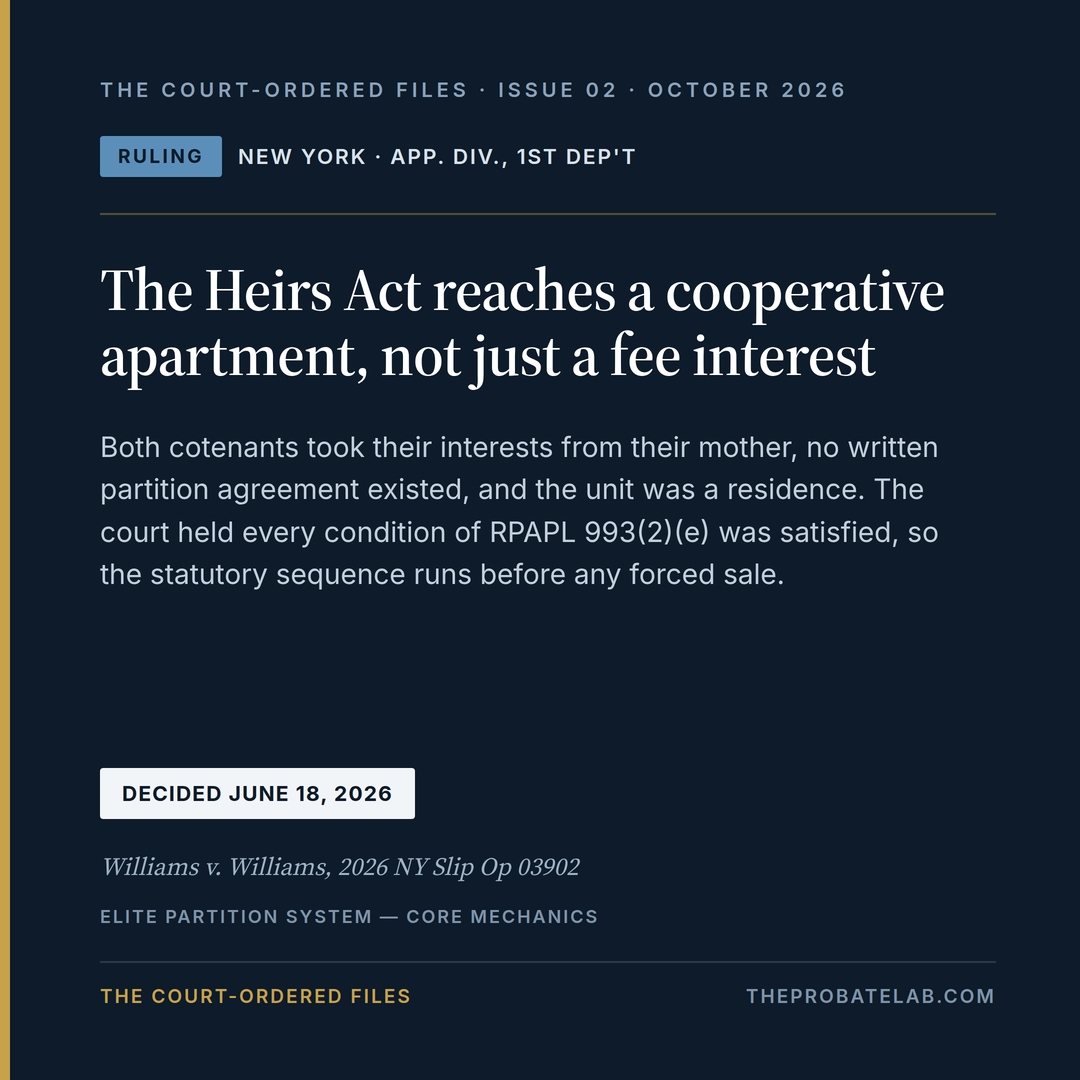
In Williams v. Williams, two cotenants each took their interest in a cooperative apartment from their mother. There was no written partition agreement. The unit was a residence. The First Department held that “the Heirs Act is applicable in this action because all of the conditions noted in RPAPL 993 (2) (e) were satisfied,” reversed, and remanded.2
That matters because a co-op is not a fee interest. It is shares in a corporation plus a proprietary lease. The form of the asset did not defeat the statute.
The act does not reach a trust and an LLC
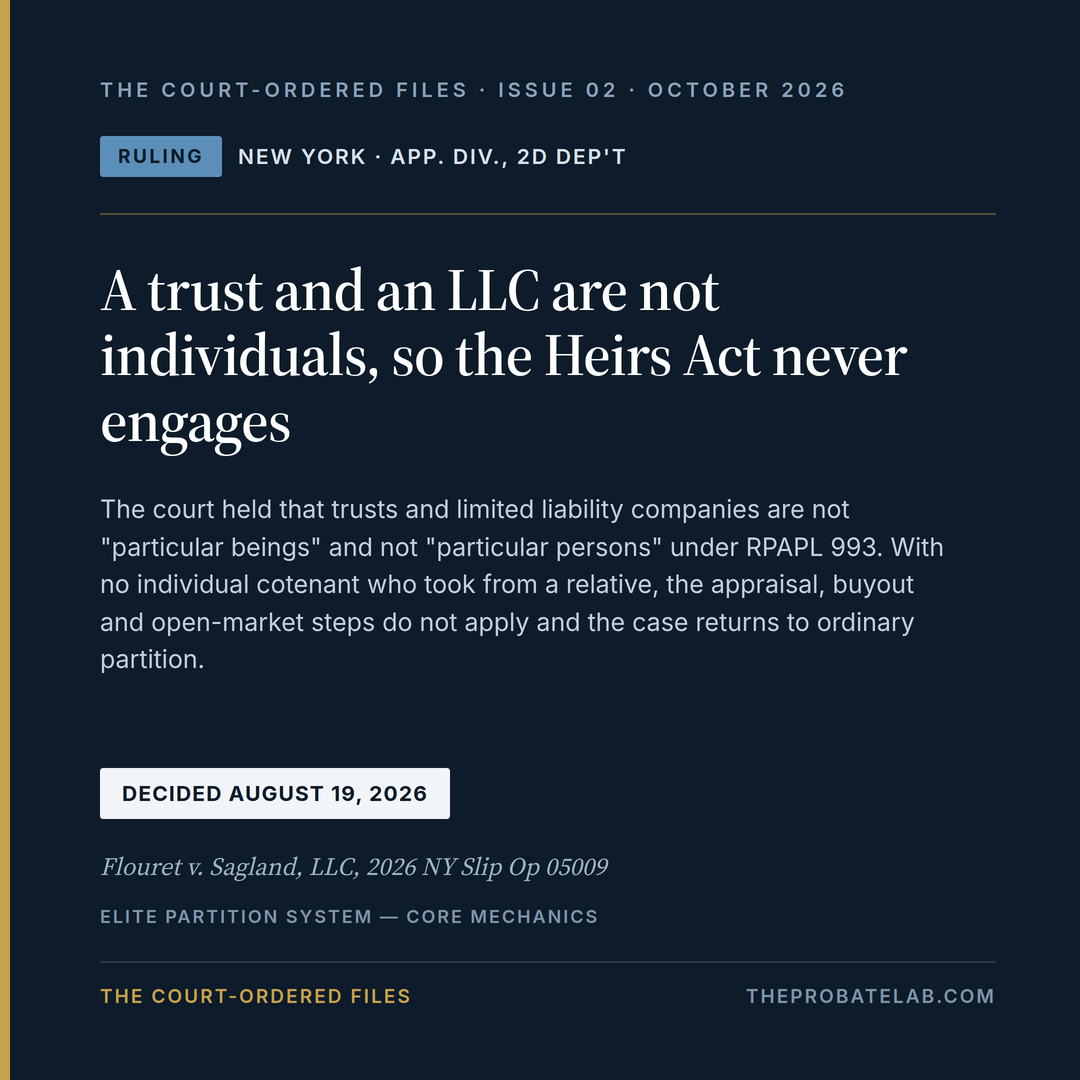
In Flouret v. Sagland, LLC, the property was held entirely by a trust and a limited liability company. The Second Department reversed the finding that it was heirs property, reasoning that “Trusts and limited liability companies are not ‘particular being[s]’ and are not ‘particular person[s]’.”1 With no individual cotenant who took from a relative, none of the act’s machinery engages, and the case returns to ordinary RPAPL article 9 partition.
So the form of the asset did not defeat the statute, and the form of the ownership did.
What that means on a file
Put the two together and the question that determines which sale procedure applies is not how the family describes the property, how long it has been in the family, or whether anyone inherited anything in the ordinary sense. It is whether, on the day of filing, an individual holds an interest that came from a relative.
That is a title-history question. Somebody moved an interest into a trust in 2009, or formed an LLC for liability reasons in 2014, and twelve years later that decision is what decides whether a court orders an appraisal and a buyout window or sends everyone to a partition sale. Nobody involved was thinking about partition at the time.
Which raises a question worth sitting with if you work co-tenancy files: on the last three you touched, did anyone pull the chain of title before deciding which statute applied — or did everyone assume, from the facts of the family, that the Heirs Act was in play?
One more thing that can stop a partition sale
Separately, and in the same department as Flouret, the Second Department held in ARLO 67, LLC v. Doyle that the Attorney General can stay a pending partition-and-sale action under RPAPL 756-a without showing that deed fraud is probable. “The agency must show only that the ongoing investigative approaches bear a reasonable relation to the subject matter under investigation and to the public purpose to be achieved.” A six-month stay was granted.3
If you price a partition file on expected timeline, that is a delay risk that sits outside the parties and outside the partition docket entirely.
These are published decisions, quoted here so they can be read directly. How any of it applies to a specific file is a legal question for the attorney on the matter.
Partition files are their own discipline. The Elite Partition System (coming Q4 2026) teaches the co-owner and court-ordered partition sale from title check to closing, in all 50 states. For probate and estate property, EPCAS™ — Elite Probate Client Acquisition System covers the same authority-first discipline.
Leave a Reply