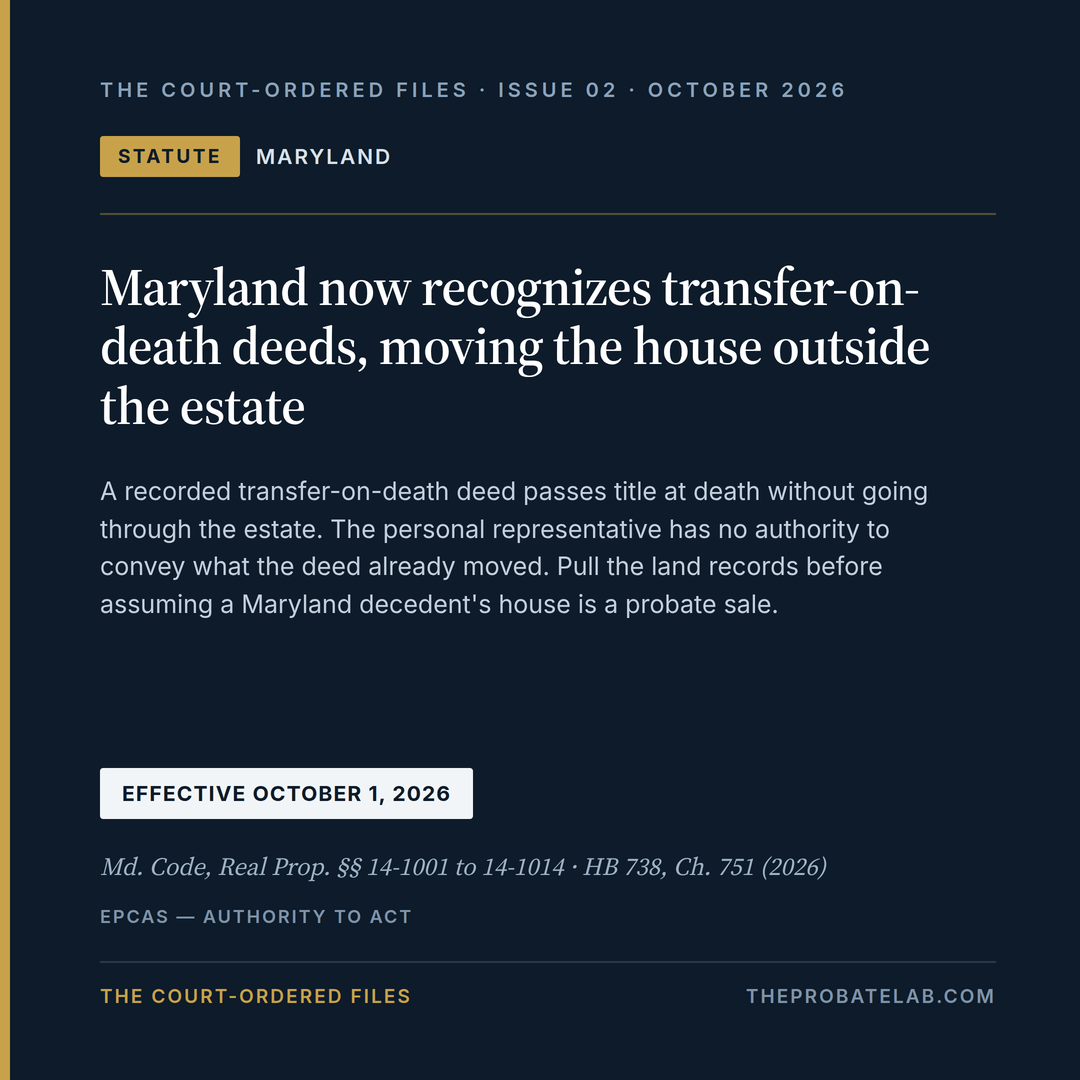
As of October 1, 2026, Maryland recognizes the revocable transfer-on-death deed. House Bill 738, Chapter 751, adds a new Subtitle 10 to the Real Property Article at sections 14-1001 through 14-1014, and amends section 3-104. It was approved by the Governor on May 26, 2026.1
Two features of the chaptered act do the real work.
First, revocability is not negotiable. The act provides that a transfer-on-death deed “IS REVOCABLE EVEN IF THE DEED OR ANOTHER INSTRUMENT CONTAINS A CONTRARY PROVISION.”
Second, nothing moves during life. The deed creates no legal or equitable interest in the beneficiary while the transferor is alive, and the property is not exposed to the beneficiary’s creditors in that period.
Where this lands on a court-ordered file
At death, a recorded transfer-on-death deed moves the property out of the estate. Out of the estate means out of the personal representative’s authority to convey it.
The practical consequence is a sequencing change. For years, the working assumption on a Maryland decedent’s house has been that it is estate property until something says otherwise. Starting today there is a document that can say otherwise, and it lives in the land records rather than in the probate file.
If a listing agreement gets signed by a personal representative on property a TOD deed already moved, the signature is from someone without the power to give it. That is not a problem you find at the listing appointment. You find it at title.
Worth noting what the act does not do. It does not resolve what happens when a TOD beneficiary and the heirs disagree after death. Co-owners who cannot agree on a sale are a partition question, not a probate one — a different statute, a different track, and a different conversation.
This article is real-estate education, not legal advice.
Learn the transaction side of probate property: EPCAS™ — Elite Probate Client Acquisition System teaches agents who has authority to sign, what the court requires, and how to run a probate sale in any state. Not sure where you stand? Start with the free Probate IQ Quiz.
Leave a Reply