
3-minute read
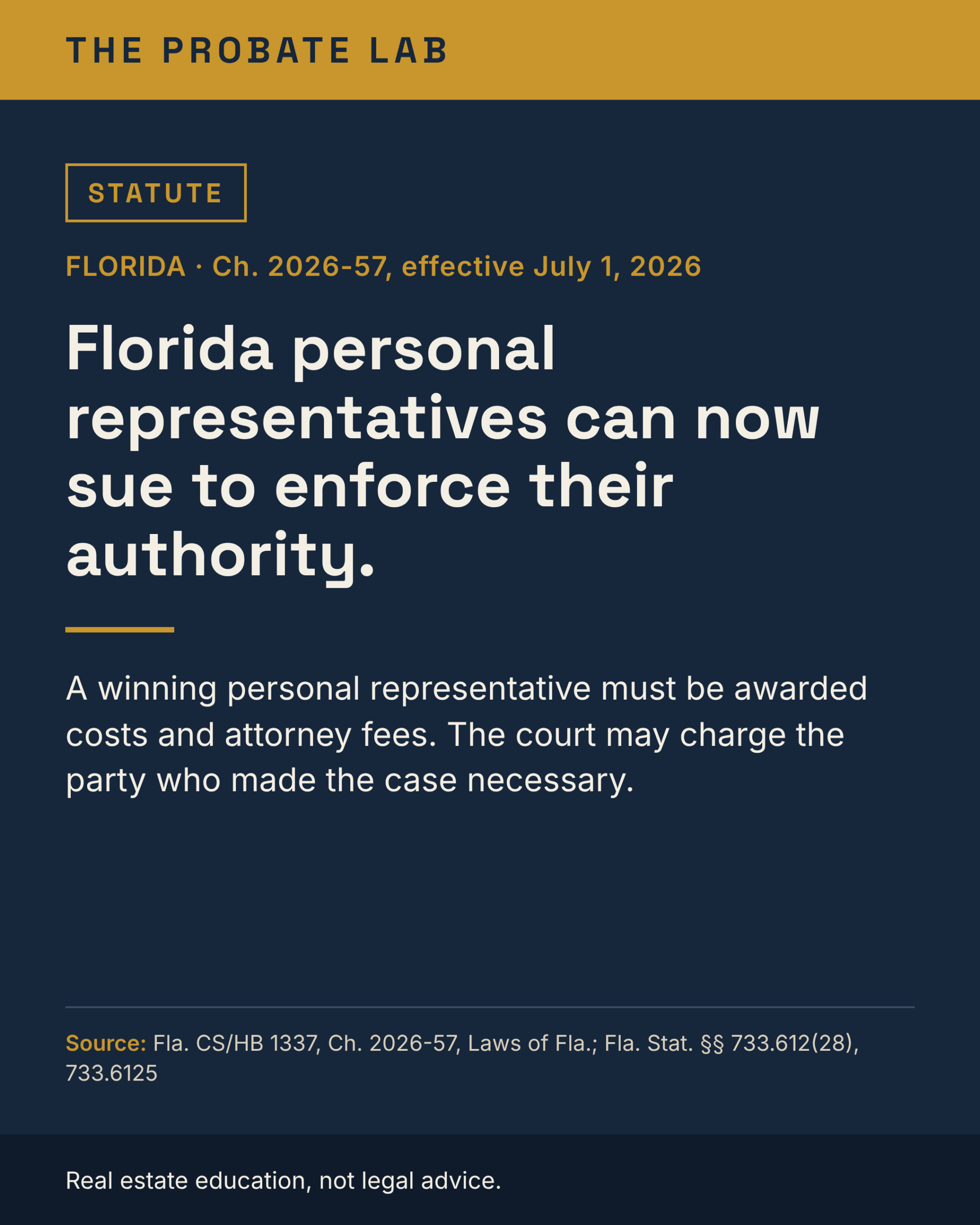
Bottom line: Florida now spells out that a personal representative can ask the probate court to enforce the powers the Probate Code gives them.[1][2] If the personal representative wins, the court must award costs and attorney fees.[3] For a sale, that changes the math when someone blocks the personal representative from doing the job.
What changed
Florida’s CS/HB 1337 became Chapter 2026-57, Laws of Florida. The Governor approved it on April 29, 2026, and it took effect July 1, 2026.[1] It added a new power to section 733.612: a personal representative may “institute a proceeding to enforce his or her authority as personal representative as conferred by this code.”[2]
It also created section 733.6125. In a proceeding to enforce the personal representative’s authority, the court shall award a prevailing personal representative taxable costs, including attorney fees. The court may direct payment from the party whose actions made the proceeding necessary, or from any person with an interest in the estate.[3]
On July 16, 2026, the Florida Supreme Court amended Probate Rule 5.025. Proceedings to enforce a personal representative’s authority under section 733.612 are now adversary proceedings unless the court orders otherwise. The rule change took effect immediately.[4] Enforcing authority is now a named proceeding with a mandatory fee award for a winning personal representative.
Where it applies
This is Florida law only. It governs Florida probate estates.[1] Before treating any other state the same way, check that state’s own probate code. Don’t carry this rule across state lines.
The real-estate consequence
The new law does not change how Florida estate real estate is sold. If the will gives a power of sale, the personal representative may sell real property without court authorization or confirmation. Without a power of sale, no title passes until the court authorizes or confirms the sale.[5] Possession is also unchanged. Every personal representative has a right to take possession or control of the decedent’s property, except the protected homestead. The personal representative may also bring an action to recover possession.[6]
What changed is leverage. Our read, which is an inference and not a holding: a relative who ignores the personal representative’s authority now faces a clearer path to court and possible fee exposure. That can shorten the standoff that keeps a property off the market. Same sale rules, stronger enforcement tool.
What agents and investors may miss
- The fee award runs to a prevailing personal representative.[3] The statute does not promise the personal representative will win.
- Fees may be charged to the party who forced the proceeding, or to anyone with an interest in the estate.[3] That can mean the heirs’ shares.
- Adversary status brings the formality of a lawsuit.[4] Expect the timeline of litigation, not a quick motion.
- Protected homestead sits outside the personal representative’s possession right.[6] Don’t assume this tool reaches it.
Enforcement is a lever, not a shortcut to a listing date.
3 questions an informed professional should ask
- Does the will give a power of sale, or will this sale need court authorization or confirmation?[5]
- Is anyone actually blocking the personal representative’s authority? Who, and has the estate’s attorney considered an enforcement proceeding?[2]
- Is the property protected homestead?[6] That changes who controls it.
Establish authority, possession and homestead status before you price or list.
How this connects to EPCAS™ (Elite Probate Client Acquisition System)
EPCAS™ trains agents to recognize authority questions before they make promises to a family. This Florida change is a live example: the conversation now includes what happens when someone refuses to cooperate, and who may pay for it. Know the authority before you promise a timeline.
This article is real estate education, not legal advice. Talk to a Florida probate attorney about any specific estate.
Sources
- Florida CS/HB 1337 (2026), “Estates,” Chapter 2026-57, Laws of Florida; approved by the Governor April 29, 2026; effective July 1, 2026. https://www.flsenate.gov/Session/Bill/2026/1337
- Fla. Stat. § 733.612(28) (2026), as amended by s. 4, ch. 2026-57. https://www.flsenate.gov/Laws/Statutes/2026/733.612
- Fla. Stat. § 733.6125 (2026), created by s. 5, ch. 2026-57. https://www.flsenate.gov/Laws/Statutes/2026/733.6125
- In re: Amendments to Florida Probate Rules – 2026 Legislation, Supreme Court of Florida, No. SC2026-0690, decided July 16, 2026 (adding Fla. Prob. R. 5.025(a)(14); text via Justia). https://law.justia.com/cases/florida/supreme-court/2026/sc2026-0690.html
- Fla. Stat. § 733.613(1)–(2) (2026). https://www.flsenate.gov/Laws/Statutes/2026/733.613
- Fla. Stat. § 733.607(1) (2026). https://www.flsenate.gov/Laws/Statutes/2026/733.607
Every source above was checked against the original on October 6, 2026.
Leave a Reply