
3-minute read
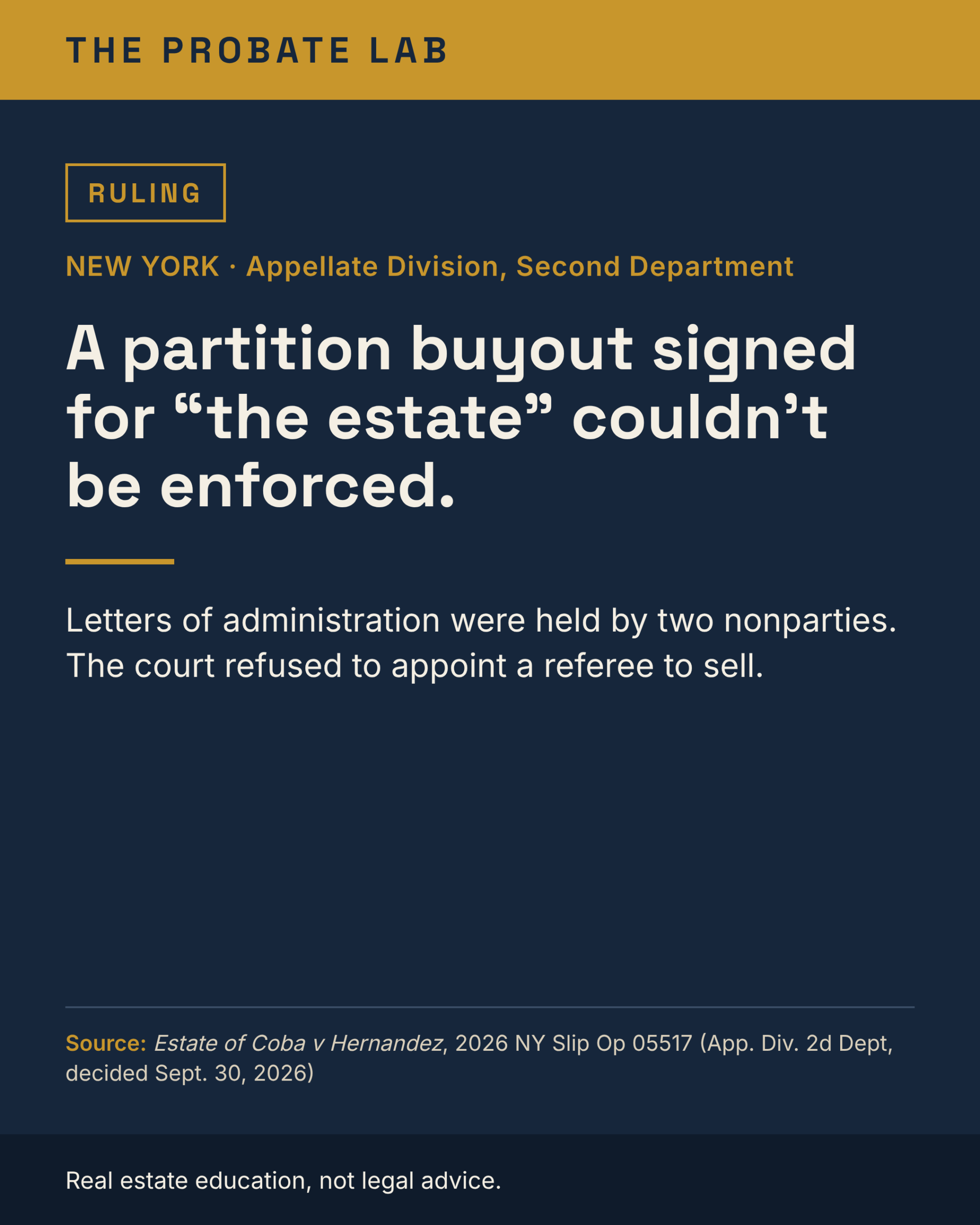
Bottom line: On September 30, 2026, a New York appeals court refused to enforce a partition buyout deal that a lawyer signed for “the estate” of a deceased co-owner.[1] The record showed letters of administration had gone to two named people who were not parties to the case.[1] If the wrong party signs, the deal, the referee and the sale can all stall.
What changed
The case is Estate of Coba v Hernandez, decided by the Appellate Division, Second Department.[1] A man who died and the defendant allegedly owned a Bayside, Queens property as tenants in common.[1] An action for partition and sale was then “commenced purportedly by the estate.”[1]
The two sides’ lawyers signed a settlement on December 5, 2024.[1] The estate’s claimed interest would be sold to the defendant by April 1, 2025.[1] If he defaulted, the estate could ask the court to appoint a referee and finish the partition.[1] The sale never happened, so the estate moved to enforce the deal and appoint a referee.[1]
Its own papers included a Surrogate’s Court certificate.[1] It showed letters of administration had been issued to two nonparties.[1] The defendant argued the plaintiff lacked legal capacity to sign the deal or sell the estate’s interest.[1] The trial court denied the motion on August 5, 2025, and the appeals court affirmed.[1] It found the plaintiff’s own submissions raised fact issues about the attorney’s capacity to sign for the estate and to sell its interest.[1] A signed settlement did not produce a referee or a sale.
Where it applies
- New York: This is a Second Department decision.[1] The slip opinion is still subject to revision before official publication.[1]
- Other states: This ruling applies New York law only. Check the local rules on who may act for an estate.
Read it as a New York signal, not a national rule.
The real-estate consequence
New York lets a tenant in common sue for partition, and for a sale if the property can’t be divided without great prejudice to the owners.[4] A stipulation in a case binds a party only if it is in a writing signed by that party or its attorney, or made part of an entered order. Agreements made between counsel in open court are the exception.[2] The court also stressed that stipulations bind parties that have the legal capacity to negotiate.[1]
The power to sell estate property sits with the fiduciary. Under New York law, every fiduciary may sell estate property at public or private sale, unless the will or the court order appointing them limits that power.[3] Here, a buyout that should have closed by April 2025 was still not enforceable when the appeals court ruled in September 2026.[1] Authority problems turn a buyout into a timeline problem.
What agents and investors may miss
- “The estate” is a label, not a signer. The court looked at who held letters of administration.[1]
- Letters can carry limits. A fiduciary’s sale power can be cut back by the order that appoints them.[3] In Coba, the letters had limitations the court called not relevant.[1]
- The other side can use the gap. The defendant raised capacity to block enforcement.[1]
- A default clause doesn’t fix capacity. The deal allowed a referee motion on default, but the motion still failed.[1]
Check the signer before you price the buyout.
3 questions an informed professional should ask
- Who holds letters for the deceased co-owner, and are they named as parties?[1]
- Do the letters, or the will, limit the power to sell?[3]
- Is the settlement signed by the right party or its attorney, or entered as an order?[2]
Ask for the letters before you rely on the deal.
How this connects to CCTX™ Partition and EPCAS™ (Elite Probate Client Acquisition System)
Partition files with a deceased co-owner are two problems at once: a co-owner dispute and an estate-authority question. CCTX™ Partition trains professionals to spot the partition side. EPCAS™ trains agents to confirm who can sign for an estate before they promise a timeline.
This article is real estate education, not legal advice. Talk to a New York attorney about any specific estate or partition case.
Sources
- Estate of Coba v Hernandez, 2026 NY Slip Op 05517, Supreme Court of the State of New York, Appellate Division, Second Department, Docket No. 2025-09653 (Index No. 719238/24), decided September 30, 2026. https://www.nycourts.gov/reporter/current/3dseries/2026/2026_05517.shtml (also via CourtListener: courtlistener.com)
- N.Y. Civil Practice Law and Rules (CPLR) 2104, Stipulations. https://www.nysenate.gov/legislation/laws/CVP/2104
- N.Y. Estates, Powers and Trusts Law (EPTL) § 11-1.1(b)(5)(B). https://www.nysenate.gov/legislation/laws/EPT/11-1.1
- N.Y. Real Property Actions and Proceedings Law (RPAPL) § 901(1). https://www.nysenate.gov/legislation/laws/RPA/901
Every source above was checked against the original on October 6, 2026.
Leave a Reply