
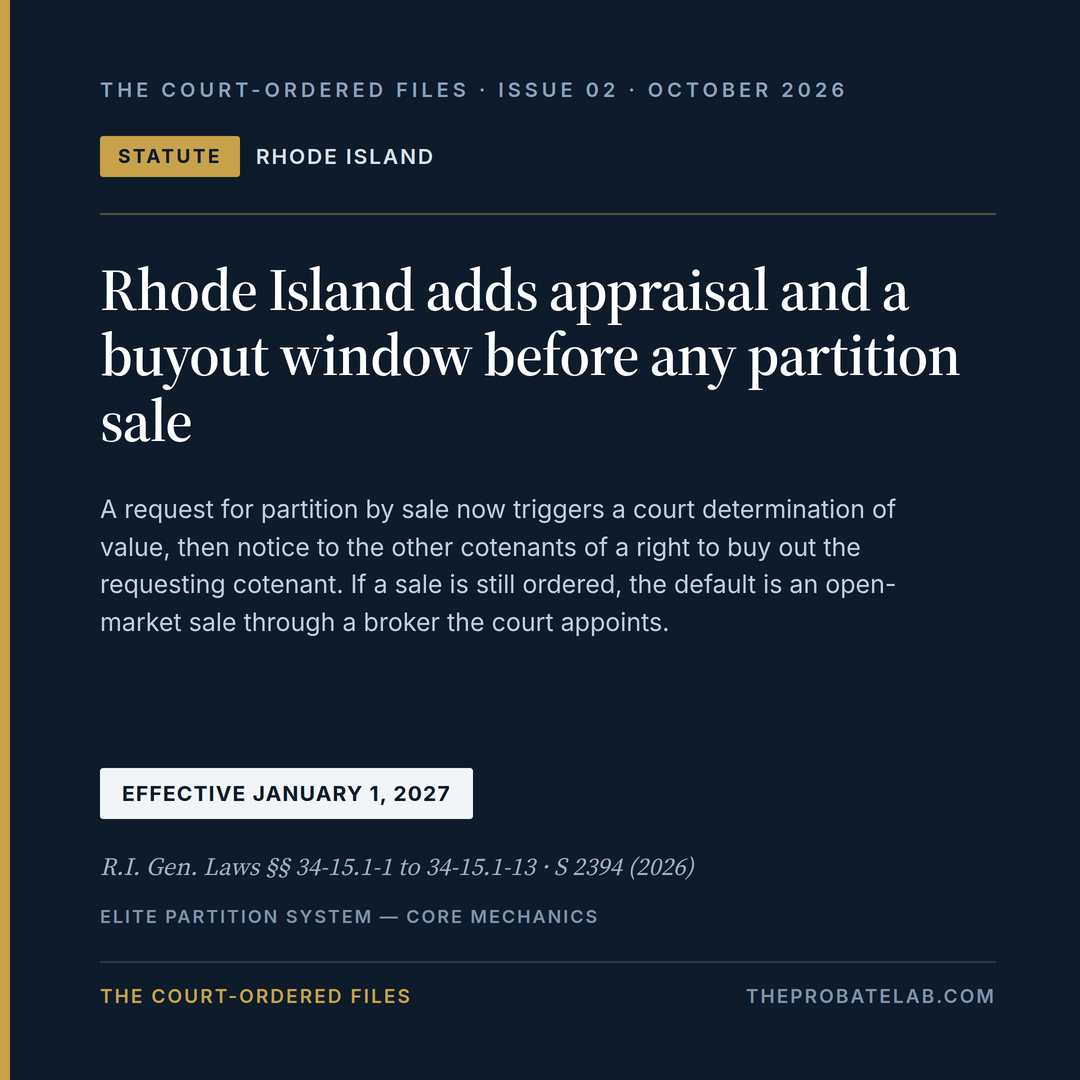
Rhode Island moved on both sides of the court-ordered sale in 2026 — once by statute, once by opinion. Read together they point at the same thing: price has to be tested by a process before the property changes hands.
The statute
Senate Bill 2394, signed June 19, 2026 and effective January 1, 2027, adds the Uniform Partition of Heirs’ Property Act as Chapter 15.1 of Title 34, sections 34-15.1-1 through 34-15.1-13.1
Where the act applies, a request for partition by sale no longer leads to a sale. It leads to a determination of value, then a buyout window. The statute provides that “the court shall, after determining the value of the property under § 34-15.1-6, send notice to the parties that any cotenant except a cotenant that requested partition by sale may buy all the interests of the cotenants that requested partition by sale.”
If the buyout does not resolve it and a sale is ordered, the default is not an auction. Under section 34-15.1-10(b), if the parties agree within ten days on a licensed Rhode Island broker, “the court shall appoint the real estate broker and establish a reasonable commission.”
That is a statutory role, with a court-set commission, created by the sequence rather than by a listing appointment.
The opinion
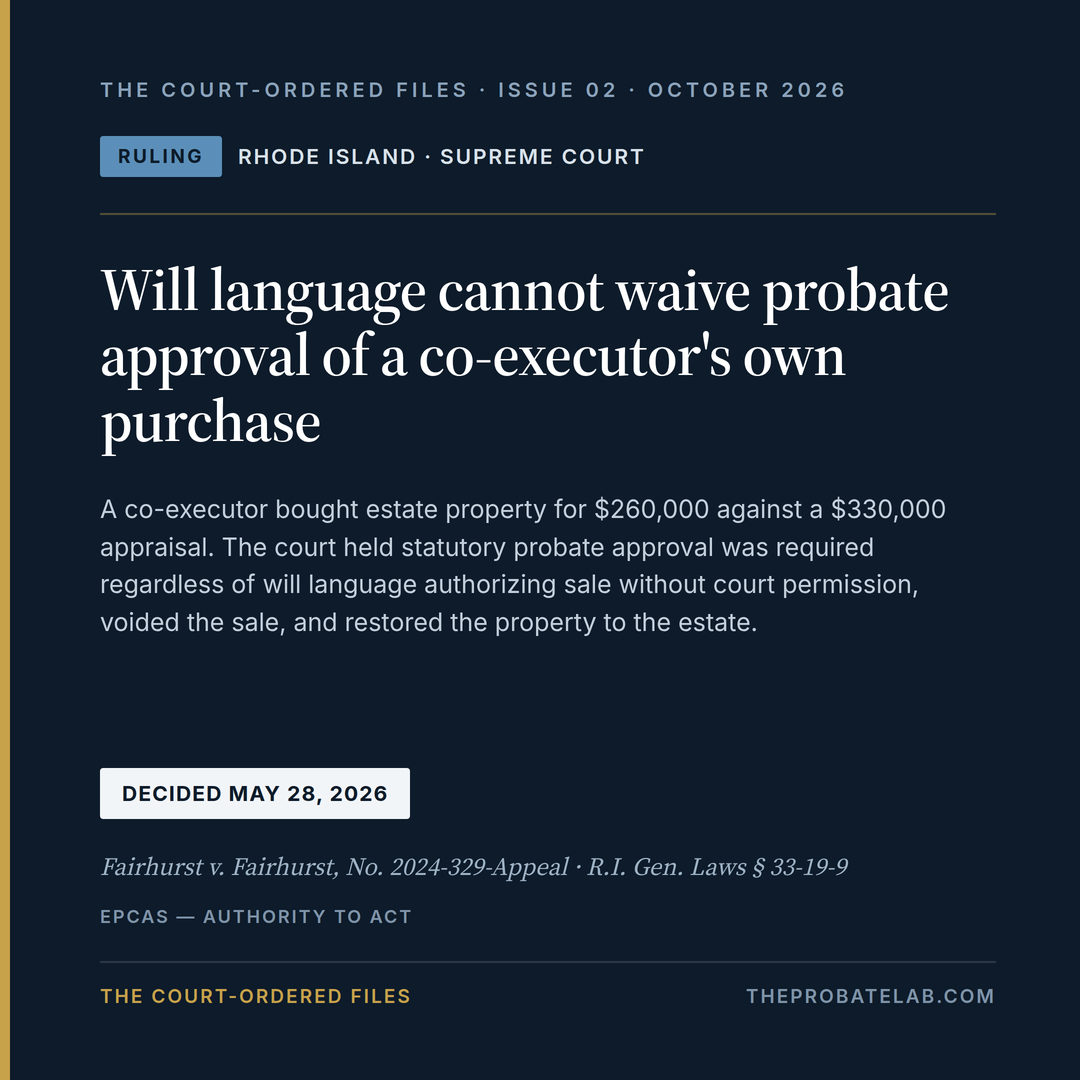
In Fairhurst v. Fairhurst, decided May 28, 2026, a co-executor bought estate real property for $260,000. In the record were a bank appraisal of $330,000 dated July 2, 2020 and a comparative market analysis listing price of $285,000 dated January 8, 2020.2
The will authorized sale without court permission. The Supreme Court of Rhode Island held that did not matter: “if William intended to purchase the property in a private sale, he was required to seek approval from the probate court” under R.I. Gen. Laws section 33-19-9. The purchase was a breach of fiduciary duty, the sale was voided, and the property was restored to the estate.
What both have in common
In the statute, a court determines value before anyone can be forced out. In the case, a court approval step exists to test whether a price was fair, and a testator could not draft around it.
Notice what was actually load-bearing in Fairhurst. Not testimony about intent. Two dated valuation documents in the record — an appraisal and a CMA. Someone produced that CMA eighteen months before anyone imagined it would be read by the Supreme Court.
If you work fiduciary files, the question is less about what you would charge for an opinion of value and more about what happens to it afterward. How many of the ones you have written in the last two years are sitting in a file that a court may eventually read?
Statutory and opinion text is quoted here so it can be verified directly. Application to a specific matter is a legal question and routes to counsel.
Partition files are their own discipline. The Elite Partition System (coming Q4 2026) teaches the co-owner and court-ordered partition sale from title check to closing, in all 50 states. For probate and estate property, EPCAS™ — Elite Probate Client Acquisition System covers the same authority-first discipline.
Leave a Reply